Know Your History!

Why is it that few modern circus artists seem to know or care about the history of circus?

The job of an artist is to be creative, rather than recreative. Knowing the history of your discipline is important; You don’t want to merely repeat what others have done before you.

It’s a good idea to know the history of the genre you’re involved in and possibly the history of other related disciplines. In a world where we know ‘knowledge is power’, why would anyone not want to know as much as they can about their passion or career?

With this in mind, why can I still have a conversation with a professional who knows nothing about the history of what they are doing!?

I’m not saying everyone needs to be an expert or want to be on Time Team, but please take the time out to educate yourself, just a little.

Circus Futures

For those of you who may not be aware there’s a large (for UK standards) circus event happening at the end of November which could prove to be very interesting….

Circus futures is a showcase/conference taking place on the 30th of November and 1st of December in Bristol designed to bring policy makers, producers and artists together.

The event will consist of keynotes, showcases and panel decisions centring around,

“…the creation and distribution of contemporary circus work in this country and beyond.”

I shall be there, probably sharing my thoughts on Twitter as I go. Hopefully there will be more artists in attendance at the discussions than there were at circus open spaces earlier this year.

http://www.circusfutures.org/

6 months and 20,000 views

Just a little pat on the back to all the contributors and content consumers. To celebrate we have a new look for the site, you can still search the site through tabs, tags and word searches. Don’t forget to add us to your RSS feed (if you don’t know what that is you should read this) and friend us on Facebook and follow us on Twitter.

If you have an idea for an article get in touch we are always looking for fresh ideas and articles.

Questions | creating VS making a living

Is it possible to be creating the new, pushing yourself and shifting paradigms (and any other clichés you can think of) while simultaneously earning bread and getting out in front of the public and strutting your stuff?

Does making a living from your art mean you limit your possibilities?

Are you a sell out if you don’t dress up as a rabbit, repeatedly jump through a hula hoop and shout “gangways” over and over again?

I think you can do both (but I’m not sure I do) but not many manage it at any rate!

Video of the Week – Marko Karvo

I first saw Marko Karvo perform in the WinterGarten in Berlin several years ago and really enjoyed his act. I was lucky enough to see him again on Monday but this time a little closer to home, at the London Palladium. I was sat 3 rows from the stage and was reminded at how impressive the precision of Marko’s movement is, how expressive his face is and by his parrot that flew over my head!

Enjoy… (skip the advert)

http://www.markokarvo.com

Bob Bramson

A third gernaration circus artists and legendary juggler, highly respected all over the world by audiences, agents and jugglers. Bramson’s act is a classic, full of charm and packed with signature tricks and touches that made him successful on stage for over half a century.
 
If you’ve had the misfotune to never have come across his work before read this and this.
 
I started this blog with the aim to engage with circus performers, to share experiences and thoughts with others. So when heard Bob Bramson’s memoirs were coming I knew it would be a must read for me.

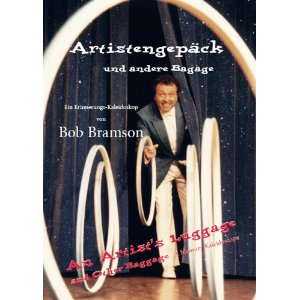
When my signed copy of ‘An Artists’s Luggage and Other Baggage | A Memory Kaleidoscope’ came through the letter box it was with more than a little excitement that I began to read.

My signed copy (showing off!)

The book is easy to consume, written in both German and English (Circus Geeks own Luke Wilson did the translation) and broken down into short paragraphs and chapters that flow nicely from one to the next. In the middle of the hardback are some historical photos and circus posters featuring Bramson and his family.

There are many anecdotes and incedents that standout; black market dealings, facing down tigers, running into the queen and techniques to quieten a crying baby. Bramson lived through the second world war and under Stasi enforcement, he took his art to new levels and had a varied and exciting career working with some of the biggest stars in the best venues – it makes a great read.

I’d recommend this book to anyone but particularly to any current or aspiring performing artists. And of course it’s a must read for anyone interested in circus.

The book is available on Amazon.

Staying healthy on tour

Traveling to a different venue each day can be exciting, fun and refreshing. But it can also be gruelling, hard on the body and mind. Here are a few tips I’ve picked up along the way…

Photo by Sura Nualpradid

Don’t be afraid to get away from the group. A common mistake to make when working/living in close proximity to your fellow artists is not taking time for yourself. Of course you want to be a team player but it’s important to have some alone time, space to think. Don’t be afraid to miss out on a nights socialising to keep your sanity!

Watch a film, read a book, surf the net – anything that gets you some personal time and not thinking about the show or tour.

Exercises. This can be a tough one, particularly if you’re doing get in/build up, performing and traveling all in the same day but it’s important to do if your used to training hard and will make you feel better. Get up 30 mins early and go for a run. In every show run I’m in I try and find a point in the show where I’m not needed and do some simple conditioning, that way I don’t need to ‘remember’ to do it, it’s as much of a habit as putting my costume on.

Eat healthy. I’ve always found this one tough but when on tour it’s even harder. Eating out can really start to lose it’s appeal when you have to do it all the time. Take any opportunity you have to cook something for yourself. Smoothies also help!

What are your tips for surviving a tour? Please leave your suggestions below!

Video of the week – Penn

Penn & Teller are my favourite magic act, their art is thought provoking, accessible and entertaining. I recently read Jillette‘s book ‘God No‘ which I really enjoyed and would recommend to anyone who is not overly offended by swearing.

Here is a nice interview with half of arguably the greatest double act of all time:

Poor Lighting

Being able to deal with less than idea conditions has been massively helpful to me over the years, particularly in the past few weeks on tour where there is little time to spend worry about lights after the get in and prop setting has been done.

Poor lighting affects almost all circus disciplines but none more so than juggling.

Here are a few training methods (some more useful than others) to help you train for poor lighting:

Practice in sunglasses
Practice directly under a bright light
Set up a bright lamp to shine in your eyes
Practice in low level lighting
Practice outdoors on a sunny day
Run your routine with someone switching on and off the lights
Practice with one eye shut (I’ve had to do a routine immediately after being accidentally poked in the eye!).
Practice with both eyes shut (are there tricks you can do blind, if so can you take advantage of this on stage?!)

Any suggestions? I’d love to hear how you train for poor lighting, leave a comment!

On the Road

20110731-110347.jpg

Although I’ve done my fair share of different types of show over the years I’ve never toured. This is my first time on the road, living out of a suitcase for weeks on end, performing at a different venue each day and unloading the set each time (it’s confirmed my suspicion that when it comes to props and staging stand up comedians have it sussed).

I’m enjoying sitting in the passenger seat, watching the road go by. I particularly enjoy the night time journeys, being driven down curvy country lanes looking out for rabbits, hairs and even the occasional dear.

Makes me think; I really should learn to drive.

Pole Dance Dictionary

Anyone interested in the documenting of ‘circus’ tricks or wanting to learn chinese pole should have a look at Pole Dance Dictionary for inspiration.

A very slick looking site, it’s just a shame they didn’t use YouTube so you could easily share videos. Also nice to see a familiar face on the site!

Pole Dance Dictionary on Facebook.

Hobby

“Beware the hobby that eats.”-Benjamin Franklin 

For many modern circus performers the ‘career’ starts out as a hobby; An interesting and enjoyable way to spend a few hours a week. Over time the passion and obsession creeps in and before you know it you’re filling in your first self-employed tax return and cursing the day you passed on a ‘proper job’.

I’ve never really thought about the transition from hobbyist to professional. I’m sure for some there comes a time when they say “right I’m going to make my living from this”, and go on to do so. But for must of us it’s a gradual incline (or decline depending on how things are going!) which we hardly notice.

Occasionally important choices will come our way and remind us that this is more than ‘just a hobby’. Whether it’s applying for circus school, dealing with a serious injury or taking a 12 month contract away from home these difficult choices are not often faced by a hobbyist.

I believe a hobby can (and should) be almost always ‘fun’ but a career is (and should be) challenging.

Does trying to pries a living from an ex-hobby take the enjoyment out of the work? Possibly. From my own standpoint I still love playing with objects, getting on stage, sharing the few good ideas I have with the world and getting a reaction and connection with an audience. I hope that if there comes a time when I don’t enjoy performing then I will change what/how I do it or move onto a new profession.

I still have to pinch myself from time to time, remind myself that I survive and even thrive (at times!) thanks to my hobby, my chosen profession.

Are there times you regret being a professional, do you aspire to be one or think your passion is best kept as a hobby? Love to hear from you on this one…