Why is it that few modern circus artists seem to know or care about the history of circus?
The job of an artist is to be creative, rather than recreative. Knowing the history of your discipline is important; You don’t want to merely repeat what others have done before you.
It’s a good idea to know the history of the genre you’re involved in and possibly the history of other related disciplines. In a world where we know ‘knowledge is power’, why would anyone not want to know as much as they can about their passion or career?
With this in mind, why can I still have a conversation with a professional who knows nothing about the history of what they are doing!?
I’m not saying everyone needs to be an expert or want to be on Time Team, but please take the time out to educate yourself, just a little.
I emerge from the cavernous depths that have been the last miles of my journey: a journey that has taken me from the frozen steppes of the northern frontier to this, the very edge of this sprawling continent. I blink uneasily in the harsh early light, and allow the warm rain to embrace my face as I turn to the east and the winding unkept path that marks the route I must take. As I step forward, my bag heavy on my back, filled only with the essentials I dare not leave alone, I espie it in the distance. My final destination can be glimpsed between the heavy and fortified walls that punctuate this barren and detail-less realm.
The behemoth.
It rises menacingly from the water. Even from this distance, it dwarves the figures and temple-like constructions around it. It’s scale causes me to freeze for one long moment. It is still a good forty-eighth of a days hike from me, but already it dominates the skyline. In that moment I know that my destination is, despite all adversity, now close at hand, and that it will be watching me as I approach: teasing me with cul-de-sacs and detours.
A long moment of hesitation. And then I stride on to meet the creature. For I know that in it’s hidden depths, deep in its hideous belly, is the woman I seek. Swept away nearly one half year ago from her home and her country, cursed to be hoisted thrice-weekly above the thousands strong throng that choose to live their cursed lives within the creatures belly. Lifted high into the air, to be tossed and pulled this way and that by ropes and other cunning devices, clad only in the thinnest of garbs imaginable, swept this way and that for the voyeuristic pleasures of the heaving multitude.
It is for her that I have made this journey. Knowing that the hardships I have endured are meaningless compared to those she must have faced. As I strode the world freely, she was pulled hither and thither upon it. Spat up upon foreign shores, to be allowed but the barest glimpse of the world outside the great creature, a glimpse that brought with it the illusion, the promise even, of freedom and choice, before being dragged remorselessfully back into its depths.
I hurry along the path. I ignore the lashing of the downfall. I am already soaked, a heady mingling of sweat and rain in this humid place. I haven’t washed for days, the floods and the acid-spitting wildlife precluded it.
As I move purposefully forward, a sudden vibration seems to enter my body. She has bent agents to her will, and sometimes she can use these minions to pass messages. I know how to decode these missives, arriving as they do not in the claws of ravens, nor on the flights of arrows, but as carefully typed words on the front of my journal and map.
She writes of The Drill. A cruel ritual that the creature seems to find a heady delight in. The most delight seems to be gained by springing it most unexpectedly upon it’s victims, and it seems that The Drill may be starting very soon. My beloved is required (or rather, is enforced, as the scent of punishment for the most minor of sins hangs heavy in that place) to spend hours in some display of penitence to her masters, to be paraded before them once more, in a cruel parody of power and hierarchy. She fears that The Drill may be starting very soon, a fact which would reduce the scant hours our reunion has been favoured with to substantially fewer. What cruel Gods or Demons are these, that toy with me even now, so close to my goal after so many months?
I walk faster. Picking my way through the detritus.
The behemoth grows larger, and my anticipation with it.
————
(I managed to visit Petra in Lisbon for a few hours during her cruiseship contract. The drill was cancelled, and the quest was successful.)
For those of you who may not be aware there’s a large (for UK standards) circus event happening at the end of November which could prove to be very interesting….
Circus futures is a showcase/conference taking place on the 30th of November and 1st of December in Bristol designed to bring policy makers, producers and artists together.
The event will consist of keynotes, showcases and panel decisions centring around,
“…the creation and distribution of contemporary circus work in this country and beyond.”
I shall be there, probably sharing my thoughts on Twitter as I go. Hopefully there will be more artists in attendance at the discussions than there were at circus open spaces earlier this year.
Tap Portugal flight 511, en route from Stockholm, Sweden, to Lisbon, Portugal. I am travelling to my sisters home in the north of Portugal, with the intention of catching my last sun of the year before heading back to Germany and shows through ’til January.
The last four weeks have been spent teaching full time. A week at the circus school in Rotterdam, a week in Tilburg, and then the last two weeks in Stockholm. I wrote the first draft of this essay back at the start of that tour, and now I have tried to clarify some things that became more clear to me over the following weeks. Much is still unclear, and although I can now state a solid intention, it may not be clear if it is a good one, or indeed a possible one!
It all started when I was sitting in the teachers room at the circus department of Codarts, the University for the Arts in Rotterdam.
Alongside me at the large table, eating their sandwiches and drinking tea, were four teachers from Russia, one from China, and one from Bulgaria.
Three of the four Russians came purely from traditional circus, the Bulgarian from Sport Acrobatics. I am not sure of the Chinese gentleman, but I believe him to be traditionally based (he was teaching Chinese pole and hoop diving, so I feel quite safe to make that blatant assumption). Classical circus backgrounds. In contrast, the theatre teacher was German, the dance teacher American. I was the only circus discipline teacher there with a non-classical background.
This situation highlights one of the longest running discussions of modern circus education. Technique vs. creation. Skill vs. art. Old vs. new. Who teaches what? Is it better to have strict old-school technique teachers (circus artists, gymnasts), and have the “art” come from external sources (theatre class, dance class), or should the combination be more fluid and involve more overlap? It’s an old issue, but being there reminded me that it is still not completely solved in a practical way.
Jugglers have historically had more of a combined technique/creation education than other disciplines. I don’t think it’s pure (or at least, not only) juggler arrogance on my part if I say that jugglers have tended to be slightly ahead on the “modern circus” curve. Partly because we can take more risks without actually dying, and perhaps partly, in an ironic twist, because of this lack of full-time juggling teachers compared to acrobatics or aerial coaches.
There is a continually refreshed pool of retired circus acrobats, of professional gymnastic coaches. Potential circus teachers. Jugglers have a longer performing shelf life: we can keep going ’till we drop, literally, dead on stage of natural causes, which means less full-time juggling teachers in the world.
Having a changing pool of guest teachers at a school, rather than or in addition to one full-time teacher, has advantages and disadvantages. The disadvantages I will ignore for now, perhaps for a later post. One of the advantages of the situation is receiving many different approaches and beliefs towards juggling, and thus being forced to search for ones own opinions and artistic feelings.
So, these guest juggling teachers tend to be active performing jugglers, and thus have a current understanding of that world, and most of them are of a generation where they are concerned with “new juggling”: with creation and choreography within the technique.
When I have but a scant week to spend with some students, I don’t wish to use all our precious class time doing pure technique classes. If I am only there for a brief time I see more value in sharing what I care about within juggling and beyond pure technique, to talk about the stuff that excites and inspires me, and to hope to give some of that energy to my students. If it seems necessary to spend some hours standing around talking about body position and making fine corrections to arm movements, then fine. But that is not my normal priority. I have to assume that they get that from other sources (that assumption is, of course, one of the disadvantages of the situation!).
Yes, it is absolutely vital to learn good technique. To learn it in a safe and clear manner, from first principles and onwards. But can we teach it in a creative manner from those first principles? If we learn the proper technique to climb a rope, then obviously we should learn leading with the other foot, with the other hand. But maybe rather than doing that because it is “good technique”, we could do it because it is an exploration of all the possibilities offered by that technique. So that already in those first steps we are dissecting tricks not only for technical reasons, but for creative ones. You’ve learnt your rope climb? OK, show me the variations, and tell me what they change internally as well as externally. Show me a rope climb I’ve never seen before, and build me a sequence that highlights each element within it. Good technique doesn’t need to be at the cost of creativity, or of exploration and play. And that play could be introduced at the same time as the technique, rather than as a separate factor, in a separate class, with a separate teacher.
I experienced an example of this technique/creation separation recently when I found myself in the slightly surreal situation of working for 45 minutes on someone’s finished act: a graduation piece after a four year circus education, which was already six months old and oft-performed. Despite it’s “finished” status I was expected to bring something new to it, and was being watched by two performance teachers. The act was a solo using the Chinese pole, and before the session I was asked “Have you worked with someone on Chinese pole before?”. My answer was “no.” If I had been more brutal and honest, then after the session I should have added “and I still haven’t.”
There was a major disconnect between the technique and the theatrical setting. It was to me a clear example of the wrong way to make modern circus. It was “I do this technique set, what theatrical story can I drop on top of that to make it more interesting?” Rather than making some kind of statement using circus technique, here was someone using the circus technique purely as punctuation. It was something in parentheses, something which was referred to rather than being the main event.
I believe this to be the direct result of separating technique from creation. Of learning the words, rather than coining new ones for the required intention. Of theatre teachers dropping circus into theatrical situations, rather than delving into the situation that is the circus discipline itself. And if the students say “yes”, if that is their final statement after a long and intense education? I find that to be a shame.
I don’t believe that there are no more tricks to find on the Chinese pole. Or on the Corde Lisse or the cradle or any other apparatus. Why don’t we see as much new technique from those disciplines as we do from the jugglers? Yes, the risk is a factor, but so is the psychology of the teachers and the students, and that is something we can take responsibility for. If there really are no more tricks to find, then let’s give up all those other disciplines and all be jugglers together!
But in the mean time, and after so many years of talking about how to create creative circus performers, let’s start by being creative circus teachers: teachers who can kick their students to learn pure technique, but who can also communicate the need for new technique. For technique that tells it’s own story, that is specific and personal and high level. Technique that contains it’s own theatricality, in addition to risk and spectacle and difficulty.
Theatre should deepen and clarify reality: so let’s start with our reality, circus techniques, and see if we can tell some new stories using that language.
Just a little pat on the back to all the contributors and content consumers. To celebrate we have a new look for the site, you can still search the site through tabs, tags and word searches. Don’t forget to add us to your RSS feed (if you don’t know what that is you should read this) and friend us on Facebook and follow us on Twitter.
If you have an idea for an article get in touch we are always looking for fresh ideas and articles.
Many people these days want to learn circus, whether it’s just for fun or fitness, or professionally because they want to be a performer.
Regardless of why you want to learn circus, the circus arts are a fantastic set of skills to have and to learn. Training in circus skills is great for strength, flexibility, stamina, dexterity and coordination, and is also incredibly social. Circus skills are used to develop physical, mental and social skills in young children are used around the world as a tool for social change with disadvantaged youth.
Depending on your age, experience and your intention (do you want to be a professional performer or do you just want to do it for fun/fitness?) there are many skills you can learn and lots of places you can learn them.
Through a short series of posts I’ll direct you to a variety of places where you can learn them. Rather than trying to list every place or circus company in the world that offers circus skills training (which I’m pretty sure would be close to impossible) I’m going to try to point you in the right direction.
Being a Londoner, I thought I’d start with circus training in London. So if you’re in London and want to learn circus skills either professionally or for fun and fitness read on…
Yesterday I watched the Bugs Bunny cartoon “High Diving Hare” and it got me wondering “what other circus cartoons are out there?” Here’s a small selection of some of the circus cartoons that I’ve found so far.
I’ve had this on standby for a while: the death of Steve Jobs seems to make now a good moment to post it.
———–
Feel free to imagine this is about choreography rather than design. And I know I can trust you to replace phrases like “use the iPad” with phrases like “watch the performance”, and so on.
What Ive and his team understand is that if you have an object in your pocket or hand for hours every day, then your relationship with it is profound, human and emotional. Apple’s success has been founded on consumer products that address this side of us: their products make users smile as they reach forward to manipulate, touch, fondle, slide, tweak, pinch, prod and stroke.
“It’s not for us to predict what others will do,” Ive says. “We have to concentrate on what we think is right and offer it up.” Ive’s focus and perfectionism are legendary. Any conversation with him is about hours of work, about refusing to be satisfied until the tiniest things are absolutely right. He’s most pleased with what consumers will never notice. He wants them to use the iPad without considering the thousands of decisions and innovations that have gone into what seems a natural and unmediated interaction.
Is it possible to be creating the new, pushing yourself and shifting paradigms (and any other clichés you can think of) while simultaneously earning bread and getting out in front of the public and strutting your stuff?
Does making a living from your art mean you limit your possibilities?
Are you a sell out if you don’t dress up as a rabbit, repeatedly jump through a hula hoop and shout “gangways” over and over again?
I think you can do both (but I’m not sure I do) but not many manage it at any rate!
I arrived at the venue at 3.30pm for my 4pm rehearsal. At 4.30pm I was finished.
Now it’s 6.30pm. The show starts at 8pm. My act is at the start of the second half.
I should start my make-up when the show starts.
Right now, there are thousands of performers all around the world doing exactly what I am doing now.
Together, in our own way and in our own places, we wait.
Does this connect us all on some level? The juggler in Berlin with the snake-charmer in Mumbai? The trapeze artist in Moscow with the preacher in New Guinea?
Breathing, sleeping, reading, stretching – thousands of us, spread across the globe in whatever passes in that particular locale for a “backstage”.
How exhilarating that realisation is! I am not alone! As I type these words, I can imagine a shared consciousness, a body of experience shared between performers of all races, faiths, and skills. Connected by the act, by the art, of waiting. But not mere everyday, amateur passive waiting – waiting not for a bus, not for a train or in a queue, but waiting for the moment of stepping onto the stage, of stepping into a more “real” reality. Waiting for the moment of transformation!
I am sorry. I think I have too much time on my hands…
I first saw Marko Karvo perform in the WinterGarten in Berlin several years ago and really enjoyed his act. I was lucky enough to see him again on Monday but this time a little closer to home, at the London Palladium. I was sat 3 rows from the stage and was reminded at how impressive the precision of Marko’s movement is, how expressive his face is and by his parrot that flew over my head!
I was required to write this short piece some weeks ago for a residency application. Originally, I was planning to take some time and really try to be as honest and clear as possible. But, as these things so often transpire, I ended up writing it in pretty much one draft just before the deadline…
So, I reckon it’s a slightly odd mix of honesty and keyword hitting, but re-reading it now, I am quite happy to share it here, and I stand behind it. And it got me to the interview, so it’s original purpose was fulfilled…
————–
Why circus?
Circus imagery is some of the strongest cultural imagery that we have. The clown, the candyfloss, the laughing child, the strong man and the beautiful ballerina, the horses and the lions. To say it is timeless would be a crass naivety, but the shared emotions that circus is still tied to are still alive, and are felt by peoples of almost all ages and cultures.
But beyond the imagery, circus should not remain a “timeless” art. Its core concepts – including physicality, strength and risk – stay ever fresh, but over time the reasons for its necessity change. We have a responsibility to keep our art form relevant and fresh. Circus is a “time art”: one that happens anew each time in real time, as opposed to the snapshots offered by painting or engraving or sketching, or the set in stone offerings of ballet or cinema, and as such it has the opportunity to develop and evolve over time, and at a quicker pace (how short our history is compared to that of music, or dance, or even cinema!).
Circus’ roots are in spectacle, fantasy and exoticism. In showing that which it was not possible to see anywhere else. Now that we can see almost anything we want, at almost any time we want to, we must look deeper into the purpose of the circus arts. Circus arts, the techniques that belong to the circus, speak their own language and carry their own emotional baggage and weight. To me, the biggest step that circus has taken in it’s recent development is that of opening it’s doors to people from outside it’s traditional families and dynasties. It is obvious to say that many circus practitioners today chose of their own free will to study the skills of the circus, rather than being born into it, and one hopes that that means that not only do they have the physical abilities to say something, but also that they have something they wish to say.
Circus as it is performed today really shouldn’t need (30 years after the birth of nouveau cirque) to justify itself as “circus with theatre”, or “circus with dance”, or “circus with value added art”. Circus should be proud enough to accept that it is an art, and then to look once more within itself to find what it wishes to communicate. I believe that not only different practitioners, but the different disciplines themselves, have personal and important things to say. Things that can be said better with circus than with any other medium.
Otherwise, what would be the point of practicing circus?
To answer the question “why circus” is to me exactly this process. Why did I become infected by juggling at the age of 14? Why did magic capture me three years before that? And why did those obsessions develop into the love for circus that I have now? What is it about juggling that speaks to me, and how can I be more honest to my artform in my interpretation and performance of it?
And what about all those other disciplines? Why do I “know” (or even have an opinion) about what a “good” handstand act is? Or trapeze or teeter-board or or or? The more the technique can speak to us, the closer we can get to the real meaning and purpose of circus.
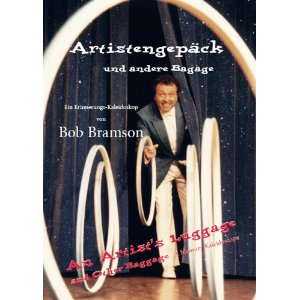
A third gernaration circus artists and legendary juggler, highly respected all over the world by audiences, agents and jugglers. Bramson’s act is a classic, full of charm and packed with signature tricks and touches that made him successful on stage for over half a century.
If you’ve had the misfotune to never have come across his work before read this and this.
I started this blog with the aim to engage with circus performers, to share experiences and thoughts with others. So when heard Bob Bramson’s memoirs were coming I knew it would be a must read for me.
When my signed copy of ‘An Artists’s Luggage and Other Baggage | A Memory Kaleidoscope’ came through the letter box it was with more than a little excitement that I began to read.
My signed copy (showing off!)
The book is easy to consume, written in both German and English (Circus Geeks own Luke Wilson did the translation) and broken down into short paragraphs and chapters that flow nicely from one to the next. In the middle of the hardback are some historical photos and circus posters featuring Bramson and his family.
There are many anecdotes and incedents that standout; black market dealings, facing down tigers, running into the queen and techniques to quieten a crying baby. Bramson lived through the second world war and under Stasi enforcement, he took his art to new levels and had a varied and exciting career working with some of the biggest stars in the best venues – it makes a great read.
I’d recommend this book to anyone but particularly to any current or aspiring performing artists. And of course it’s a must read for anyone interested in circus.
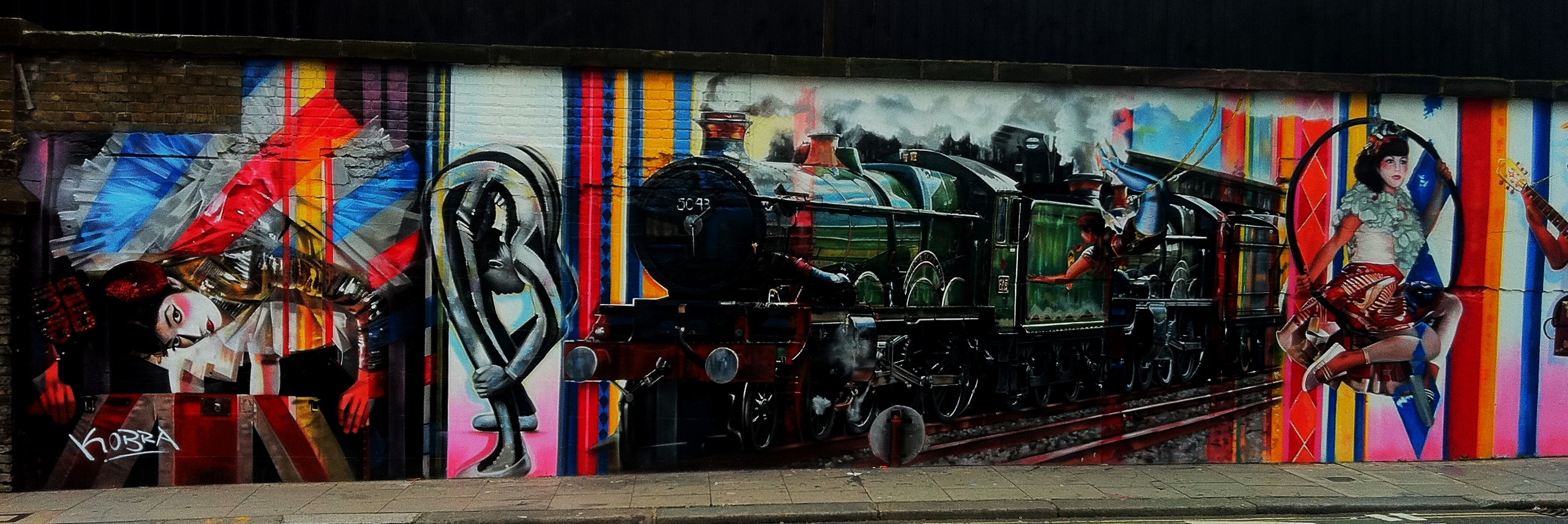
This piece of graffiti art is in support of Circus Child and located just to the north of the Roundhouse, Chalk Farm, London. Circus Child identifies and supports social circus projects around the world.
The handbalancers trained only on floor (their theory; if you can do it on the floor then you can do it on canes.) The floor was wooden and uneven which meant that people would use things to even it out, using a plank of wood or anything that was flat.
The teacher was Victold a 74 year old man, he was very delicate and polite. On my first day he told me ‘do whatever you want so I can see what you can do and I will help tomorrow’ well, an hour later he came over and said ‘shoulder weak – push more, gufus/figure bad and 1 arm lower to croc bad, everything else, good’…that was it. I guess it was a compliment that he wanted to help me straight away, or I was that bad he had to start straight away!
He then held my hand to do a straight one arm, if you were off balance or out of shape he didn’t say or do anything, if your shoulder dropped he would say ‘push push’, which seemed to be his main concern. Gufus/figure; again he held my hand in straight 1 arm and made me get into it from there and then held my feet. I found that very odd and off putting, I couldn’t really balance but it’s just another technique and it’s good to try them all. He made me do it on both sides (I hate my left side it’s alien to me) Lower to croc he completely changed my technique and I found it so hard, I found it really odd though because all the people that could do it used a different technique to the teachers, and all the ones that couldn’t would do it the teachers way. I now do it the same as the students, without purposely changing anything. He then also made me do gufus/figure holding a pole that had 2 wires running off to the floor which you would rest your feet on, perfect for positioning. For the proceeding 3 days he made me do each of those exercises with him 3 times. Every day he would say this was nice, that was better and then, lift your legs more. He would always start positive then say something I should work on and then leave. It was really nice instead of everything being negative, it would also be something simple, like lift legs, squeeze bum or push in the shoulder. But all he really ever seemed to say was; push more and stronger legs.
He was one of those people that you always wanted to impress especially because he was so nice.
Victold would teach all his students certain exercises, his basics…
1st – handstand, look through at your chest and then pike down to 90 degree, back up to handstand and head back through. This was for stretching and opening the shoulders and working on your line.
2nd – Cartwheel in to a handstand, no wobble, no sticking the chest out. Just cartwheel and stick the exact right shape straight away then cartwheel out, do both sides. Again this was just for shape.
3rd – Handstand pirouettes, this is for keeping shape and pushing in the shoulders. You would do quarter turns.
4th – From a handstand, tuck down and as you push up to straight hop of the floor as high as you can and land in a straight handstand without your shoulders sinking and your back letting go so you are solid like a piece of wood. Some people could make this look quite surreal.
5th – In a straddle handstand rock to 1 arm and take your hand off straight away and touch the knee and back down and then the other side. So you don’t take your time and make sure everything is ok, you just have to do it straight away to learn to be in the right shape. Straight away. Every time. I found this really good because it would also make you really strong if you went too far and had to pull it back.
About the individual Handbalancers
In our little training area of handbalancers there was 5 of us; me, Rimma (female), Andrei, Denis and Romeo (all male.)
Rimma had just started handstands properly at the school, I spoke to her the most because she had the best English and wanted to get better at it. She was 17 and an ex rhythmic gymnast, though it was a long time ago so she didn’t have as good flexibility. She was a great person and made my stay so much better. So, for the whole 8 weeks I was there all she did was: with little wooden blocks on the floor, handstand on the block, transfer to 1 arm and push the block away and place that hand on the floor, then transfer to the other hand and again place on the floor and then back up onto the blocks. At the beginning she could do 1-2, at the end of my stay she could do 10, no one else could. That is nearly all she did all day every day (except condition lower to croc and planche and then do a few sides, but I would say 80% of her time was spent just going up and down on those blocks.) Absolute dedication and persistence. Just before I left we said try and hold a 1 arm and she held for 5 seconds comfortably. An extreme way but it works.
Andreiwas 19, quite big but very flexible, flat in box splits in a handstand and toes on hands in Mexican. Andrei was the best technical student in handstands, but he was in fourth/final year. He would train the same sequences day in day out – that’s if he came in, Andrei was one of the few that didn’t always come in. His tricks were straight 1 arm on right into pike gufus/figure, push through to legs together in a 1 arm side on left then lower down to croc 1 arm on right, slowly- and I mean more controlled than you have ever seen.
Andrei Katkov
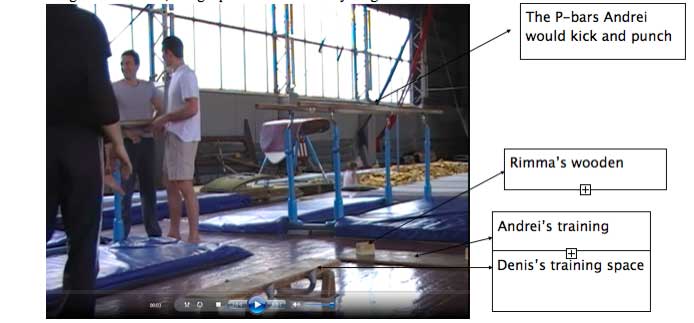
He would also train katkov (as seen above, named after Andrei Katkov)that would be his main sequence, he was the most solid there, but he also would kick and punch the p-bars if he messed up (which made the rest of us get angry – especially me, I didn’t need help getting stressed with handstands).
Mana Handstand position
I would train mana (as seen above) with him and we would train 7 sets of 10 seconds , sometimes holding flat, holding past and pulsing from low to past. Due to his flexibility he had some really nice acrobatics, free walkover, free tinsika and a capoeria move, the rest of his tricks looked odd and heavy.
Weirdly enough he was quite un-coordinated, he was amazing at what he could do but not at other things. I remember we were all messing around trying to do pirouette while holding your leg in split at your face and he would literally fall over every time, like his leg was too heavy for him to kick up or he would kick it up and take his own leg from underneath him, the same with illusion turns. It was a very funny day. One big problem with Andrei was his wrist, it was always badly injured, and one morning when he was complaining about it, I just grabbed his arm and started to massage his forearm, something simple. A lot of people know about doing this (but they don’t have a physio, so could be hard to know anything) anyway he couldn’t take any pain; he was terrible, screaming like a girl but after 5 minutes he went into a handstand and couldn’t believe how much better it was. Bad idea for me, then everyday someone wanted me to massage them and fix them. I think Andrei will be amazing and I hope that his wrist won’t affect him. At the end of each day Andrei would finish conditioning 1 arm lower to croc holding the radiator and going down as slowly as possible, he would also then do a sit up combination lasting about 3 mins which a lot of people knew and did, seemed a little pointless to me though. I think we will be seeing him next year or the year after, he’s going to be good.
Denis, the most dedicated there, he was 18 and had done circus and gymnastics from a young age. People would joke and say that he was ‘stupid like a bench’ because he wasn’t great at English and would say and do funny things. He was a good friend of mine and we trained hard together (he is one I miss a lot). In the morning he would stretch like the rest and then do back arch raises. He would ask me to stretch his feet and his knees (he would say it in English and I would say it in Russian, neither very well) then Denis would make his make-shift equipment (see picture above). He would train straight 1 arm, gufus/figure, leg’s together and 1 arm lower to croc. His thing was 1 arm hops, transferring arms and hoping on the same arm sideways, though if he was on his right arm he would hop right, whereas I go left and most people I have seen do which was interesting. I asked why he went that way and not the other, he had no answer, that’s just what he did because no one taught him or told him different, the teacher would help or correct shoulder than say do it another way.
After training handstands he would start training his airflares. This was big in Ukraine (Artur’s influence) but wasn’t seen as a hard move. Then for conditioning he would do 3 sets of 5 handstand press ups on something higher so he would go all the way down. We did this together and at the beginning I couldn’t even do one but because no one was spotting anyone I had to man up and do it alone, I now can do at least 4…I struggle on the 5th. Some of the bases did this but no one could do it like Denis and no other handbalancer did or could. Then he would go and do 3 sets of 5 muscle ups on the rings. This was common for a lot of people and was again seen as easy. I really think Denis will make it big, with a little bit of help with choreography, he got laughed at by the students for how traditional he was…
Romeo, was very quiet so I don’t know much about him. He did handstands and straps. He was amazing at straps, he was so strong. He would press all the switches on both arms and just muscle everything with ease. He had only just started handstands when I got there so was only doing straight straddle and tuck with his fingers on the floor. By the end due to his strength he was holding them all for 5 seconds. He then started to practice sides and flags, he would train plaudits slot and was getting good at them because he was so naturally strong.
One day Artur came in and asked if we wanted to play handstands add on. Hells yes I do! (Artur is another one that if he says something I will just do it, no questions asked) so he did a move, then I did his move and then added mine onto the end. It was great because it wasn’t about getting anyone out, we had people playing who couldn’t 1 arm yet, it was all about pushing each other, trying things you don’t usually do in your own training and staying in a handstand for as long as possible. It would end up being over 3-4 mins easily.
A quick discussion on the differences in schools
So, we had the usual conversation comparing schools and I told them about my school and I explained to them that I was getting, at the most 5 hours of handstands a week, now they got 23 hours a week, they couldn’t believe that’s all I got, and they were shocked and a bit confused – they even complained they didn’t get enough hours. Then I told them that those 5 hours was just me and my teacher, no one else, just the teacher and me doing exactly what he told me to do, with him spotting, correcting and pushing me to get better. Now they couldn’t believe this, they thought it was amazing but couldn’t figure out what was better – they just never considered being able to have it that way, of having a one on one class.
Traveling to a different venue each day can be exciting, fun and refreshing. But it can also be gruelling, hard on the body and mind. Here are a few tips I’ve picked up along the way…
Photo by Sura Nualpradid
Don’t be afraid to get away from the group. A common mistake to make when working/living in close proximity to your fellow artists is not taking time for yourself. Of course you want to be a team player but it’s important to have some alone time, space to think. Don’t be afraid to miss out on a nights socialising to keep your sanity!
Watch a film, read a book, surf the net – anything that gets you some personal time and not thinking about the show or tour.
Exercises. This can be a tough one, particularly if you’re doing get in/build up, performing and traveling all in the same day but it’s important to do if your used to training hard and will make you feel better. Get up 30 mins early and go for a run. In every show run I’m in I try and find a point in the show where I’m not needed and do some simple conditioning, that way I don’t need to ‘remember’ to do it, it’s as much of a habit as putting my costume on.
Eat healthy. I’ve always found this one tough but when on tour it’s even harder. Eating out can really start to lose it’s appeal when you have to do it all the time. Take any opportunity you have to cook something for yourself. Smoothies also help!
What are your tips for surviving a tour? Please leave your suggestions below!






 CircusGeeks.co.uk
You must be logged in to post a comment.