Category: Circus Geeks Blog
The CircusGeek blog, from kitten juggling to plasticine tight-wire. Circus and other odd things.
Happy New Year!
Now that’s out the way, time for a shake up…
The Circus Geeks website is going to be changing look and feel in the next few months.
Back to more regular blog posts about the wider circus world as well as more information on our new tours and shows.
The spreadsheets are done, Google maps charted, reminders set.
We hope to see you in 2015.
Make it a good one…
Video of the week – Béla Kremo
Before there was Kris there was Béla
Remarkable List
Stuff I find remarkable in 2014 – Seeking it out and then…
Watch:
- Capilotractées
- Slightly Fat Features – Variety soup
- DV8 – John
- Confirmation
- The Great Spavaldos
- English National Ballet – Lest We Forget
- Stewart Lee Comedy Vehicle series 3
- High Maintenance
- Toast of London
- Bronson
- Gravity
- Tony Hawk Sync
- Too Many Cooks
- Gandini Juggling
- Wes
- Tony
- Patrik
Read:
Listen:
- Skeptics Guide the the Universe
- Comedians Comedian
- RHLSTP
- The Bugel
- Serial
- No such thing as a fish
- Penn’s Sunday School
- Click
Sit in:
Drink:
- Kernel Black IPA
- One Hells of a Beaver
- Camden Town Brewery Versus Mohawk black IPA
- Brew By Numbers Black IPA
- Mikkeller Pale Ale
Eat:
Use:
Video of the week – Perch Balance
Warning after the perch there are some questionable acts…
Video of the Week – Voronin Brothers
Luke Wilson – Moisture Festival – April 2011
I’m currently sat in a hotel lobby in a foreign country typing on a MacbookPro Retina, which Luke would have particularly have approved of. Not only for my superior choice of technology, but also the pretend rock star status of living on the road.
I went through periods of seeing Luke every day, almost every waking hour for a few months, to seeing him randomly once every few months. So it’s only recently that I’ve really come to appreciate that I’m never going to see the particularly skinny Englishman again. Until now it was possible that not running into Luke was an unfortunate side effect of busy calendars. But now, 2 years since his death, I think my brain has fully accepted that meeting Luke is not going to happen again.
Sadness asides, I thought it would be interesting to those who never knew Mr Wilson or his work to use this anniversary as an opportunity to analyse a little of his work and try and understand some of the detail and reasoning in his compositions.
I’ve been watching a version of Luke’s club routine (which he mentions in Repetition, posted on Circus Geeks), filmed by Alan Plotkin. In Alan’s words, “This was the last time I filmed Luke Wilson. It was at Moisture Festival 2011 at the Vashon Island venue. I challenged him before the performance to go drop free and he nailed it.”
Unfortunately I never got to see this version live so I am almost certainly missing detail which video cannot convey. I did however see two versions of Luke’s older club routines live and Luke shared a couple of different older versions on video with me.
You can watch Luke talk briefly about his Moisture festival here:
The Moisture Festival version is my favourite of his club routines and in my opinion the most interesting and developed. It gives a clear definition of Luke’s artistic choices and yet leaves a couple of unanswered questions.
Act breakdown
Luke stood sideways on stage looking across stage- not at the audience. He is holding 5 clubs- two clubs in his left hand, visible to the audience.
0:28 Routine starts
Places 5 clubs one at a time precisely on stage in a line, using his hands and feet. Reminiscent on Sergei Ignatov. http://juggling.tv/160
0:41 Hands in pocket, takes a moment to collect the image.
0:44 Foot lingers, almost flirtatiously around the first club
0:49 Hands out of pockets in stylised way.
1st Club kicked up. Manipulation thumb roll sequence
0:53 2nd club kicked up
0:57 3rd club kicked up – juggle walks forward and turning
1:00 Stand still – leaning into juggle run
1:04 4th club kicked up – 4 in doubles, classic fountain. Walks forward – odd feet – reaching for the remaining club
1:15 5th club kicked up
1:21 Triple into scissor catch in squat. Looks at audience.
1:26 Club down – fake drop – foot catch into 4 club routine: multiplex
4 club fast triples
4 club singles
53 iIn triple singles – turing backwards in a circle
Switch to synchronous – splits
1:59 High throw into multiplex bend back
2:02 Freeze with odd catch. Look at audience. Manipulation turn
2:10 Careful placement of balance – finger – cross armed set 3
2:14 Clubs with a balance – left-handed start – 3 chin rolls – drop into 4 – 53 chin roll turing
2:26 collect
2:27 Pass club around body getting lower until on the foot.
2:31 Kick club causing it to roll on floor
2:34 Odd jump – pick up other club
2:35 Slow hand – look at remaining club – turn walk to it with purpose
2:43 5th club in kick up position – look at it
2:44 Kick up into multiplex pattern
2:57 Scissor catch look at audience – club still rocking gently
3:01 Stand up
3:05 Turn and throw 2 clubs away*
3:09 Almost a new person – new routine
3:13 Odd feet and club movements – puppet like – repeating patterns
Odd patterns, placements and wrist traps – odd starts and stops
linking moves, half turns
3:52 Chin roll combinations
3:57 Chin roll reverse cascade
4:01 Balance
4:06 Multi placements
4:09 Helicopter kick up – backcross combination – flat front 44strange1
4:15 Stylish 2 on a 342
4:20 Wilson 52242 wrong-end
4:22 Squat again – fast juggle – doubles with music
4:25 Fast doubles
4:27 Flats turning
4:33 High throw – Ignatov – slapbacks – half turns
4:45 Catch all 3 in right – squat – look at audience
4:52 Fake hard throw of one club
4:54 Slow 1 club slide – lego – puppetry movement style
5:05 Point
5:09 Helicopter wrist trap kick up – Luke signature
5:44 Ends kick up sequence
5:47 Contortion cascade
5:50 Under arm trap – problem and solution
5:57 Leg catch freeze – build up tension
6:04 Triplex kick up
6:07 1 up Pirouette
6:09 Throw clubs behind him
6:14 Bow
6:24 Exit stage
Luke starts the routine standing still on stage, not looking at the audience – an interesting choice. It isn’t till a few seconds in that he looks at the audience, allowing them to take in his appearance and identity. Before that first look Luke is almost secondary to the props, the oddity in his moment and choices are clear but we don’t know how he feels about it.
The juggling begins with Luke kicking up into a 3 club cascade, he turns in a circle allowing the audience to take in this first and most classic pattern. From then on there are only a few classic juggling patterns which have been chosen for specific reasons. Most of the act consists of juggling created by the performer, something which used to be a rarity in juggling.
The first compliment (freeze) allows the audience in, before we have seen a window into his world, a taste of skill and things to come but that eye contact allows us to catch up and take Luke in. The freeze itself is an interesting position, in a sitting squat, far from a unusual ballet-influenced circus poses.
The section where Luke is continually moving and adjusting his legs, arms and clubs are a slight (but only slight) exaggeration of his OCD tendencies. Going for a coffee with Luke could be fun; moving the cutlery or various napkins off-centre would result in him subtly readjusting till everything was back to being in its rightful place, square and proper.
Watching Luke warm up every night for several months was also a chance to see how much he enjoyed systems which would be carried out pace for pace, throw for throw every night. Luke enjoyed his discipline. These puppet-esque movements sit very well with his energy on stage and yet are surprising and unusual, far from the normal movement qualities jugglers traditionally use.
The precision of placing the club into a balance on Luke’s head, is something that is common in many of his routines. Moments of careful precision that Luke was so excellent at, the weight and gravitas he gives the prop and the detail of the pinky finger out – reminiscent of a delicate tea cup which Luke was so fond of and makes for an important moment, heavily contrasting with some of the fast and complex juggling that has preceded it.
Luke runs his own version of a classic 423 kick-up using wrist traps to catch the kicked-up club (Luke help popularise wrist traps in club juggling, taken from another juggling prop – the devil stick. Luke invented many variations with wrist traps, now commonplace in contemporary juggling). This pattern is run for 33 rounds and lasts over half a minute. It’s an unusual choice of trick to run for so long.
Luke has chosen a unique trick to him, subtle in detail. It would be easy to miss the wrist trap if it were ran for only one or two rounds and it’s not a particularly difficult trick in a single repetition. As the pattern plays out the tension builds, we see Luke begin to struggle from the shear repetition and final relief when he breaks out of the loop. Repeating the pattern for so long allows the audience to take in and possibly understand the juggling and gives effective dramatic build in the act.
Luke also particularly enjoyed kick-up tricks which may also explain why he chose to repeat his 423 variation. He finishes the routine with a triplex kick-up, a trick Luke loved and is covered extensively in this video tutorial we made together in 2009.
The pirouette is the final full stop for the juggling, enforced by the dropping of the clubs**. The holding of breath as the audience begins to show it’s appreciation and the exhale of relief helps underscore how much concentration has gone into performing such a complex and well thought-out performance.
Luke was a talented magician and I can see it’s influence in the whole routine, particularly in his bow which was obviously thought out and practiced. The unbuttoning of his jacket and classic open hand position reminiscent to me of dove magician, Lance Burton as was Luke’s immaculately folded sleeves.
Luke left nothing to chance and thought out every detail of his work. Everything had been gone over with a fine comb, from the choice and variation of prop (Luke could probably have written a book on this subject) to his method of rolling up his selves.
Perhaps the biggest lesson for me to take from Luke’s work is to question every choice, be aware of every decision. Do what you believe in.
I miss Luke.
**The dropping of the clubs really confused me. When studying on my degree Luke taught lessons examining at the nature of status and how we treating our props on stage adds to the communication of how much an audience should care about what we are doing (trying not to drop in the most part).
Theories for Luke’s end throw include, it was as simple as a stylistic choice or that he got carried away after performing such a perfect routine. However both these reasons don’t fit well with me, they don’t take into account Lukes meticulous nature or his lessons on giving the props value.
For my money, the best guess comes from Jay Gilligan, he said that in one of the MRL laboratories Luke was exploring the idea of finding an ending that could not go on. Jay went onto say, “in one case his [Lukes] solution was to make an ending that was not only conceptual but also literal in the sense that he threw the clubs away from him, preventing any further contact and therefore erasing any doubt at all that he would continue.”
* At 3:05 into the act Luke turns and throws 2 clubs away. It looks slightly award and messy, if we understand the end drop then I cannot fathom this prop dump. My only attempt to grasp Luke’s choice here is that it’s a stylistic choice (or someone was supposed to take them from him?). I wish Luke was around now so I could quiz him about it.Many thanks to Lauren Hendry, Sean Gandini, Jon Udry and Jay Gilligan for their thoughts and feedback.
Video: Cirque du Soleil Does Its Thing… With Drones
Although I’m not a fan of the narrative styling it’s great to see the circus company giant look to work with technology. Hopefully in the future we will see circus mix with the drones.
Circus words
As circus in the UK grows into an accepted art form I’ve noticed that the amount of cliche, buzzword, artspeak bollocks being used to describe work seems to be on the rise.
So I thought this might be useful for any new circus companies looking to up their game:
My work explores the relationship between gender politics and unwanted gifts.
Video of the week – Lilly Yokoi
BT@BJC
Next April we will be performing <Beta_Testing> at the British Juggling Convention . Jon, Matt and myself all have a history with the constantly evolving event – it’s where we first met. As teenagers we grew up attending various juggling conventions and they’ve given us inspiration and opportunity along the way.
We’re delighted to be performing the show for such an informed juggling audience and will be interested to see and hear more jugglers perspectives on a show which introduces the outside world to juggling.
See you in April!
Metal
I smell of metal or more accurately, I stink of Iron. And I now have a tiny insight to what it must be for aerialists to love their large, impractical geometric shapes. Moving them from gig to gig, no wonder they are so strong. Metal is heavy, perhaps I’m stating the obvious, I’m stating the obvious but I appreciate that mundane fact in a whole new way after the last 5 days.
I’ve been at Pangottic HQ, in their studio/workshop, helping build being a general dogsbody for Matt who is chief engineer on Project_Vee.
Project_Vee is a collaboration between CircusGeeks and Pangottic. It’s a chance for us to bring to life a prop/structure/apparatus that we have only seen on video and love, a chance to push our technical skill in a whole new direction (literally) and a chance for me for to try more outdoor work.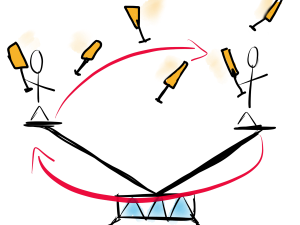
I’m in uncharted water but in safe hands, a dangerous sentance that overuses cliches but is also reflective of the situation. Matt knows building; his last couple of shows have been feats of engineering extravagance. But over the last few days we’ve both been scratching our heads. For me it’s when I don’t know which gloves I should wear; welding gloves or builder gloves? And for Matt, will the stress load at 38 degrees be ok for the 2786KG winch or not? Each learning in our own way.
Metal dust gets everywhere, in your clothes, in your hair, under your finger tips and on your water bottle. Projects like this bring take you to new places, places you never thought about, places you thought would have disappeared, unneeded in 21st century Britian. Worlds that you don’t belong to, fascinating to see over the counter of a shop or at the entrance to a yard.
Project_Vee is the adaptation of a famous (at least to the juggling world) act, making it possible for us to perform this spectacle, out doors. Allowing new audiences to experience a juggling treat.
Metal takes effort to cut, energy and sharp blades. It’s noisy and punishes you if you’re not paying attention. It takes ages to clean up and is a pain to join. Welding scares me.
But now we’re halfway through the build and despite the graft I’m like an excited kid on Christmas Eve.
Back to building next week.
Project_Vee premiers June 2015, and we can’t wait!
School
I went to circus school with a very defined out come. I met that goal and learnt other stuff as well. Not everyone has the same experience or needs.
I found this Intelligence Squared debate on the nature of art schools interesting, perhaps you will too.
Pricing
The post is in the context of performance as entertainment and not art. Debates on the differences can be had another time, if you like.
*This is aimed at the London cabaret scene but it may well apply to other markets. I used to perform fairly regularly on the circuit in question. The following debate goes round and around in many different scenarios and places of work.*
It goes:
Performers complaining about being undercut by (in their judgement) newbies who are naive and ruining the market by being happy to work for peanuts, undercutting the established market.
Employers take advantage of newcomers and lower their overall fees, safe in the knowledge that they will be able to fill these less lucrative spots.
Some complaining comes from performers who seem to have goldfish-like memories, forgetting that they were indeed the very newbies who were undercutting the established professionals only a heartbeat ago- and at the same time overlooking the fact that when starting out it is unreasonable to ask the same fee as an established competitor.
Being offered a fee lower than you are used to is rarely intended as insult- if that’s the best insult they could come up with then I’d love to see how generous a compliment is! Therefore taking offence at a monetary business transaction is an odd way to respond.
In a market with many privately acting 3rd parties, with free movement of labour and relatively high (globally speaking) fees it is all but impossible that a union could bring about price fixing.
Look at how the music industry collapsed in on itself, pretty much overnight, thanks to digital music distribution and media. This could give you perspective on how stable the cabaret circuit currently is. There is no obvious great innovation waiting in the wings about to topple careers. Charging less money is hardly an innovative or particularly sustainable business practice. Probably the biggest threat to your long term income is changing public behaviours (remember when seeing a burlesque show was not on the list of stuff to do on a Friday night?) or the acts on offer becoming stale/mundane.
So what are the options? Are there solutions?
It’s pretty straight forward economics, supply and demand. It’s no different from any other market; if you are competing in a crowded market then your margin will go down and your quality must go up.
If you want to be paid well, you need to be unique. Simply put, you need to be in demand.
That may sound contrite but I think it’s at the heart of the problem. You have very little chance of controlling what others can/should charge, very little chance of convincing venues/promotors to not book cheaper acts which to them are comparable to you.
If you can prove your worth then you have a great chance of keeping/increasing your fee. Prove your worth in any way you can; if that’s professionalism, quality of your costume, talking up your rockstar status or convincing them you are the second coming of Jesus. Or you could up your game and make better stuff that’s worth paying more for.
Your other option is to challenge the notion of markets, to bring about social and political reform on a very large scale but that debate is probably best discussed at other places on the internet.
Also worth reading on similar topics:
http://thebryonykimmings.tumblr.com/post/67660917680/you-show-me-yours
http://illshowyoumineyoushowmeyours.tumblr.com
And an interesting counterpoint
The Making of Beta Testing

Why make a show?
Luke Wilson was a teacher, colleague, mentor and friend. He inspired me to set up Circus Geeks in March of 2011. Circus Geeks started out as a blog set up after a particularly late night conversation between myself and Luke. Although memories are fuzzy from the night’s events, the definition of juggling, art and how to make the perfect pizza were all discussed. As well as this, a mutual agreement was reached on the lack of information, ideas and connection circus artists manage to share with each other and the wider world. So I set up a WordPress blog, bought the URL and Circus Geeks was born.
At the time, I was performing my solo act in various venues around Europe and was getting a bit down about the idea of working in venues for long stretches away from home or venues in London which offered audiences that were more up for a night on the town rather than seeing a piece of circus.
I graduated with the act in 2008, so by 2012 I was no longer getting the same excitement I got when I first performed it. The solo with the silver cups and balls in Beta Testing was based on the feelings I had doing my graduation piece over and over again.
To be good at juggling (or anything) requires a massive amount of repetition. Typically this attitude of repetition has been continued into the artistic practices of some of the best jugglers of all time. Many have performed 7-10 minute numbers in cabarets, music halls, variete and circus. Their acts didn’t vary too much, perhaps a change of trick once in a while or a new costume but pretty much set pieces to be performed 100s of times, finding different audiences for each performance. Luke wrote an interesting essay on the subject of repetition which you can find on the Circus Geeks blog here: https://circusgeeks.co.uk/2011/09/04/repetition/
After reading Seth Godin I realised that I needed to make an active choice to constantly create new work, find people who were interested in my work and share it with them. Upon reflection I realise it’s what Gandini Juggling do so well (a company I have worked with intermittently since 2008 and has had massive influence on my juggling and views on art).
I knew that performing interesting, new circus work in the UK can be hard as audiences are not aware of what circus (perhaps ‘alternative circus’) can be. I’d always been obsessed by TED (in 2009 I had watched every TED talk there was) and wanted to give my own. I thought that making a show somewhere between a TED talk and a circus performance would be something I’d love to see and making it about juggling would help audiences in to a world very alien to them. It would be an interesting challenge.
I also knew I didn’t want to make a solo.
I met Matt and Jon in the early to mid 2000s at juggling conventions. We became friends and saw each other at juggling conventions. Matt graduated from at Circomedia and Jon studied as an electrician’s apprentice (we still get the occasional story from Jon about how he was electrocuted or how he ruined some poor clients kitchen by drilling holes in their ceiling by accident) but he dropped out, moved to London and made the shift to professional juggler. Matt went onto found his own circus company, PanGottic.
In October of 2012 I asked Matt and Jon if they were interested in Beta Testing, they were both up for it. Each has their own solo shows, so for the first version on Beta Testing we supplemented a small amount of new material by borrowing from their existing work.
We went on to be awarded the Propellor Prize in March 2013, which enabled us to make more material and a more cohesive show, which was premiered at the Roundhouse CircusFest in April 2014.
Beta Testing Inspiration
I like recommendations from sources I trust – almost everyone does.
Here is a list of stuff that have influenced the show and stuff we love:
TED talks
– All of Seth Godin’s TED talks – Arron quotes him in the solo scene where Arron is juggling and talking at the same time. – https://www.ted.com/speakers/seth_godin
– Jay Gilligan – https://www.youtube.com/watch?v=YB_sfnwbgvk
– James Randi – http://www.ted.com/talks/james_randi
– Rodney Mullen – https://www.youtube.com/watch?v=uEm-wjPkegE
– Richard Dawkins – https://www.youtube.com/watch?v=VxGMqKCcN6A
Juggling
– DROP – Luke Wilson
– Red/Blue – Luke Wilson -http://www.renegadesignlab.com/diversions/redblue.html
– Smashed – Gandini Juggling – http://smashedjuggling.com
– Water on Mars – Tony Pezzo X Patrik Elmnert X Wes Peden – https://www.youtube.com/watch?v=Ppgy_9yx5-w
– Flowerpot – Clockwork – http://juggling.tv/171
– Anatoli and Viktor – http://juggling.tv/121
– Anthony Gatto – http://anthonygatto.com
– Dieto – http://juggling.tv/633
– PeaPot – https://www.youtube.com/watch?v=4wO3Ua1lmrU
– The Qian Brothers – http://juggling.tv/1541
– Sean McKinney – http://www.seanmckinney.com
– Robin Gunney – http://juggling.tv/5023
– Kris Kremo – https://www.youtube.com/watch?v=wzkoZH1JKmo
– Ball Sticks – Guy Heathcote – http://juggling.tv/2042
– Pomp, Duck & Circumstance – Donald Grant – http://juggling.tv/1798
– Alexander Kiss – http://juggling.tv/343
– Bobby May – https://www.youtube.com/watch?v=U6ZUoqxWwMo
– Sam Veale – http://juggling.tv/906
– Steve Rawlings – http://juggling.tv/2504
– The Two Marks – http://juggling.tv/257
– Ty Tojo – http://www.tytojo.com
– Bob Bramson – http://juggling.tv/364
– Jay Gilligan – http://www.fourthshape.com
– Erik Aberg – http://erikaberg.com
Books
– The Lynchpin by Seth Godin
– The Tipping Point by Malcolm Gladwell.
– 4000 Years of Juggling – Volume I & II- Karl Heinz-Ziethen
– The Hitchhiker’s Guide to the Galaxy – Douglas Adams (Radio plays over books every time)
-Steal Like An Artist- Austin Kleon
Random
– http://sethgodin.typepad.com/seths_blog/2011/01/two-truths-about-juggling.html
– Stewart Lee – http://www.stewartlee.co.uk
– Robin Ince – http://robinince.com
– Penn & Teller – https://circusgeeks.co.uk/2013/03/19/public-fan-letters-penn-teller/
– Steve Jobs – https://www.youtube.com/watch?v=D1R-jKKp3NA
Week by week break down: https://circusgeeks.co.uk/?s=beta+testing+-+creation+week
The show
Scene break down
Endurance
The idea of Jon juggling as the audience arrived came from watching the DVD of Anthongy Gatto setting the world record for 7 ring juggling as an audience around him ate their dinner. Anthony juggled 7 rings for 15 minutes and 6 seconds finishing with a 5 ring pirouette.
In Beta Testing(BT) Jon juggled 5 balls for 5mins, which is hard to do under pressure. We did some training for it 6 months before the show and Jon was managing close to 20 minutes. It’s interesting to see how showmanship can be used or ignored to manipulate how an audience will react to a trick.
Keynote
The opening idea for the show comes from a piece I made about learning 5 ball back crosses. The piece grew from a performance I did at Jacksons Lane as part of a Lab:Time showcase in June 2012. Since then I’ve tweaked the slides and script but ultimately the key themes of the piece have remained the same, showing an audience the process a juggler goes through to learn a trick.
Jon’s Ring routine
Originally set out to remix and reference jugglers of the past with accompanied projected visuals but after initial testing we decided to scrap that aspect. Instead we have a really nice routine that helps lift the show after its initial text-heavy piece.
The Dreaded Question
This monologue comes directly from an early and popular post on the Circus Geeks blog. Steve Ralwlings helped us connect the scene with the lead in of the heckles, helping set up the tone for the piece.
The Lexicon
Again this scene started from a popular post on the blog, written by Erik Aberg. When we first showed it to an invited audience we received mixed reactions. But after scrapping some material, reworking and clarifying intentions with Steve we arrived at a scene which is very fun to perform and normally well received. Our review from the Evening Standard says this scene alone is almost worth the ticket price.
Red/Blue
The idea of the colour change and playing on my colour blindness came after I was looking into colour theory and ways it could be used in juggling. I wish Luke could have seen me perform it.
Gentlemen
Matt and Jon both had sequences and tricks with everyday objects so it was logical to tie them together. Chair juggling was something I’d wanted to try for a long time, so we spent a few interesting (and scary) days throwing furniture at each other.
Act Art
This scene changed little as I went through the creation of BT, so there’s not much to be said. The original act can be seen here: https://www.youtube.com/watch?v=EMTvvphbdVU
Ring Passing
Originally the idea was to explore drops, setting up the idea of apologising for each drop, as the drops went on the apologies would get grander and increasingly ridiculous.
But after various experiments we came to the version in BT, it’s more a window into a world that only jugglers normal see. The truth is myself and Jon can easily perform the trick, at first we didn’t have any script or set material but the more times we performed it the more things we found to improvise around. Setting a structure allows us to guarantee (some degree) the piece isn’t too flat but isn’t too strict so we can be sure the piece stays fresh for us and in turn the audience.
Chop Suey
Chop Suey came very late on in the creation period, only 10 days before we premiered. Steve Rawlings pushed us to create a scene that was a bit lighter than some of the other scenes and fill it with juggling. It was refreshing to be a bit silly on stage.
Fish
The original concept was looking at risk and consequence. If a high-wire artist falls off they die; if a juggler drops, it’s a bit akward. Even when juggling seemingly dangerous items like fire torches the consequence of something going wrong is usually a lot less than the perceived risk. We thought it would be interesting to make a real understandable consequence.
Throughout various showing we experienced with the amount of attempts, juggling balls, music and even size of fish. The optimum is the version on the video. On the last night of our premier run at the Roundhouse we had the salmon and rainbow trout cooked up for a celebratory feast!
Big Balls
We spent 2 weeks in La Breche in France working with Howie Bailey to develop the ‘big ball’ scene. It comes from various Lab:Time work I’ve done with Howie before, working with 3D mapping and projection. The juggling in the scene is not the most technical but the prop, lights and pressure of hitting cues make it a very hard scene to get right.
What next?
Circus Geeks are currently applying for funding from Arts Council England to support a tour of the show in small-scale and rural venues across the UK. Fingers crossed!
Supported by:


Video of the week – CIRCUS IN AN ABANDONED FACTORY
While I don’t particularly care for the Victorian ‘theme’, this is a really well made video by CIRCULUS and Remy Archer. Some great camera and production work, as well as some nice circus. And who deosnt like a pyro or two?!
Old School Acrobatics
Crazy tricks on tables with a dose of enthusiastic drumming for good measure.
Check out Naftalinoff’s Youtube Channel for loads more old school acts from Variety and Circus – worth a look.
Trust
Here is a video created by BuzzFeed and Cirque Du Soleil: Why trust is worth it
This is hardly a ground breaking concept and the tricks chosen don’t really scream ‘trust moves’ to anyone who has a working understanding of acro and it’s potential.
Perhaps the video feels a little cheesy because the text is spoken about the performers and not by them (possibly the accent and rhythm of the voice over just grates on me) it is still a bit of a style change for Cirque (with a capital C). Not a video I would straight away associate with their athstetic.
The video also doesn’t match the style or artistic choices for the show it is advertising, Totem. Not that it should, just interesting that it is a different approach to promotion from the normal ‘reporter in a harness on stage’ that we are all so used to seeing featured in the ‘and finally’ item on TV news. Perhaps this is the future of circus advertising?
Aesthetically it’s a move away from bad 1980s graphics and toward 1990s Calvin Klein adverts. But perhaps that’s just BuzzFeed having some artistic influence on the video?
Interesting collaboration anyhow.
 CircusGeeks.co.uk
You must be logged in to post a comment.