Fidelity

I write most of my blog posts in trains, many in cafes, and some in aeroplanes. I am in the train now, travelling from home in Cologne to work in Freiburg. I was there yesterday already, and did my rehearsals and so on, but then decided to travel home for the night, to return today for our first two shows (at 4pm and 8pm). That means I got home last night at 10pm, and left again this morning at 6am. Why would I do that?

My first juggling clubs were Spotlight European classic-long, with oil slick European style decoration. This particular model of club was pretty much the standard in the UK at the time (1990 or thereabouts), and so they were easily available and well suited to buying in case you wanted to pass with someone else. I chose the decoration because one of my heroes at my local juggling club had them too.

One of my major inspirations in my early juggling life was the Dutch juggler Michiel Hesseling. The company Oddballs had released a video of his club juggling, and I fell in love: with his Converse high-top shoes, his smart button-down shirt, his juggling, and his clubs. Red metallic Die Jonglerie Stage clubs with white handles. Beautiful creatures they were. Resplendent, slim and elegant. A trip to the juggling wholesalers Butterfingers in Bath took place, but alas, these clubs were not to be found. But, the American manufacturer Todd Smith had just released his Satellite club! This was a gorgeous creation, well proportioned, solidly built, and clad in a never before seen deep purple metallic decoration. Also, the Russian juggler Sergei Ignatov had apparently given them his blessing. I bought a set.

They were great clubs! They had a couple of idiosyncrasies that needed to be adjusted to, but otherwise, mighty fine! I juggled them for a couple of years, until I finally took the step to special order the Die Jonglerie Stage clubs after which I had always pined. The decoration I chose was more subdued: two simple bands of silver wrapped around the pure white bodies.

At this time (1995ish) I was heavily influenced by the video tapes being released by the International Jugglers’ Association (IJA) of their festival held in America each year. Many of the jugglers I respected and attempted to emulate were using clubs from the American manufacturer Renegade. In the UK, a very small group of people used these clubs, but they too were people I looked up to. Almost impossible to find in any UK juggling shop, I ordered a set directly from Renegade, and waited with anticipation for the package to make it’s way through customs and into my eager hands.

Finally, they arrived. As I was expecting, they were heavy, they were solid. This was the first time that I understood that props are tools. Built for a purpose, built to last, by craftsmen, for artists. Add to that the romance of Californian built clubs, assembled in a small workshop by the founder of the company, rather than mass produced playthings constructed in an anonymous factory.

They were heavy, and soon I removed the silver decoration I had ordered, and let them fly naked through the air.

A heavy club has always been good for me. I am naturally a fast juggler, and heavier props help to keep me grounded and calm. Especially on stage, I find a heavier club incredibly beneficial. My experience with passing with Renegades has also been great: it’s like throwing a small, laser-guided missile. Where you throw, they arrive. Other clubs always seem to include a slight vibration, an uncertainty of their exact position or speed. Renegade clubs for me have always contradicted Heisenberg’s famous principle.

Over the next years, I tended to use standard Renegade clubs for passing, and the slimmer variety for my solo juggling. I also occasionally switched to other clubs (Henrys’ Pirouettes or Delphins), but after a few weeks (or after my first show with the new clubs) I would always return to the standard, undecorated Renegade club. I could trust them.

On my recent trip to Stockholm and Portugal, I happened to juggle briefly with Delphins, from German manufacturer Henrys, and PX3s from Italy’s Play. My issues with each of these clubs would take a whole extra post or two, but I did notice how little effort I needed to juggle them, due to their slimness and light weight, and I began to doubt again my commitment to Renegade.

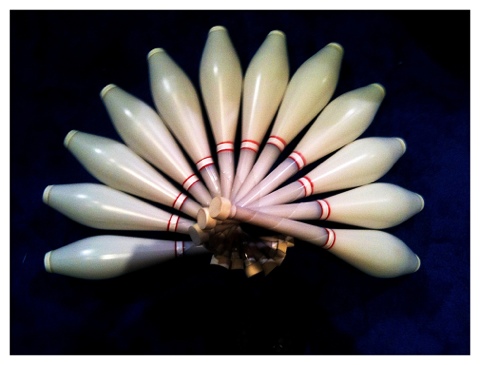
I had three days at home before starting rehearsals in Freiburg, a contract where I will be performing around thirty shows. The perfect opportunity to try some new clubs! I ran around in Cologne from juggling store to juggling store warehouse, and put together a set of six brand new clubs: Henrys Circus Classic, with red metallic decoration and silver handles. Beautiful, beautiful creations. My training with them was great, and I made sure to bring only those clubs with me to Freiburg.

Yesterday was my lighting rehearsal, and, for the first time I can recall, I had major problems getting the lights how I needed them. I have always considered myself to be extremely flexible and easy with my lighting requirements (something that jugglers are normally famous for not being). I have even turned up at rehearsals where the technicians have told me that they had heard I can juggle in any light, but yesterday it was basically impossible to build something that allowed me to see my own juggling patterns on stage.

My new clubs looked glorious from the audience, but I tend to prefer it when I can see them myself too. Was it the decoration? Was one reason I have always been easy with lights the white clubs I have used for so many years? Perhaps yes, and, given the choice between seeing and not seeing, I would take seeing every time.

But how to know for sure?

And so when rehearsals were over yesterday (in addition to my juggling act I am performing three magic pieces with the MC, Ken Bardowicks), I more or less ran to the train station to jump in a train back to Cologne. I packed my Renegades, fell into bed, and woke to my alarm clock.

And now I find myself in a train again, travelling back to Freiburg, annoyed with myself, but mostly just shaking my head at my own stupidity. I will try my Renegades in my light, and see if there is any difference. But I think I know how this affair ends. Every couple of years I try a fling with some new club, but I always go back to Renegade…

Thank you Tom, thank you Iman.

www.variete-am-seepark.de
www.renegadejuggling.com
20111103-083346.jpg

Bob Bramson

A third gernaration circus artists and legendary juggler, highly respected all over the world by audiences, agents and jugglers. Bramson’s act is a classic, full of charm and packed with signature tricks and touches that made him successful on stage for over half a century.
 
If you’ve had the misfotune to never have come across his work before read this and this.
 
I started this blog with the aim to engage with circus performers, to share experiences and thoughts with others. So when heard Bob Bramson’s memoirs were coming I knew it would be a must read for me.

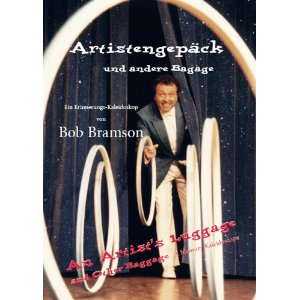
When my signed copy of ‘An Artists’s Luggage and Other Baggage | A Memory Kaleidoscope’ came through the letter box it was with more than a little excitement that I began to read.

My signed copy (showing off!)

The book is easy to consume, written in both German and English (Circus Geeks own Luke Wilson did the translation) and broken down into short paragraphs and chapters that flow nicely from one to the next. In the middle of the hardback are some historical photos and circus posters featuring Bramson and his family.

There are many anecdotes and incedents that standout; black market dealings, facing down tigers, running into the queen and techniques to quieten a crying baby. Bramson lived through the second world war and under Stasi enforcement, he took his art to new levels and had a varied and exciting career working with some of the biggest stars in the best venues – it makes a great read.

I’d recommend this book to anyone but particularly to any current or aspiring performing artists. And of course it’s a must read for anyone interested in circus.

The book is available on Amazon.

Building a new act.

Exciting times. After about 8 years with more or less the same material I’m about to make drastic changes. I have always built my acts after the same pattern. Lately I have found myself completely bored by that form.

• A piece of music. Composed for the act.
• A choreography set to that music.
• Music finished. Finale trick, take a bow and outro music.
• Exit

Simple but boring. I want to make something different. Or new. New to me. I want to use music but I want to edit exciting music to fit my act. In this way I’m going to have the possibilities of jumping between tempos and different pieces of music and add moments of recognition to the audience. I can use the music to change characters. I can go from a happy energetic persona to a pompous figure or what ever.
I can change “skill”. Blablabla.

I have to excuse my language earlier. Its not that its boring to make a choreography to a set piece of music. Its just that I need to do something with my material to find the joy again. To completely change route.
I used to get really excited about making a start at a new act. 8 years ago when I constructed the act that I now so badly want to change I was super excited and the ideas came flying. And it worked well. I have done that act for about 1500 times.

And now its time to move on.
But how do I start? It would be great to use this blog and its readers and writers to get some input and inspiration. How do YOU set everything up when you start with a new piece? Id like to hear your thoughts about it. Lets create together.

I stop now. I wanted to write about my method and about my idea. It turned out I have a wage idea and NO method. So I need a discussion with you guys. Give me your tips and your secrets : )
I’m going on tour now. For a year. But Internet is everywhere so lets meet there.
//David

Poor Lighting

Being able to deal with less than idea conditions has been massively helpful to me over the years, particularly in the past few weeks on tour where there is little time to spend worry about lights after the get in and prop setting has been done.

Poor lighting affects almost all circus disciplines but none more so than juggling.

Here are a few training methods (some more useful than others) to help you train for poor lighting:

Practice in sunglasses
Practice directly under a bright light
Set up a bright lamp to shine in your eyes
Practice in low level lighting
Practice outdoors on a sunny day
Run your routine with someone switching on and off the lights
Practice with one eye shut (I’ve had to do a routine immediately after being accidentally poked in the eye!).
Practice with both eyes shut (are there tricks you can do blind, if so can you take advantage of this on stage?!)

Any suggestions? I’d love to hear how you train for poor lighting, leave a comment!

IJA Judging – A Manifesto

Notes from a discussion between Lana Bolin (IJA competitor (2001/2002) and judge (2004/2005), Françoise Rochais (IJA Individual gold medallist (1995) and performer and judge at international circus festivals), and Luke Wilson (IJA competitor (1999) and judge (2011) and performer at international circus festivals).

We believe the current judging system in use by the IJA (International Jugglers’ Association) for the purposes of deciding the Juniors, Teams and Individuals Championships to be over-complicated and flawed. We believe it to be overly focused on delivering fast and non-debatable results, at the expense of not allowing the opinions and experiences of the invited judges to contribute to the results.

We understand that it is the result of past issues with the judging systems used, but we fail to see its strengths and advantages over previous systems.

Until recently, the judging criteria was divided into two broad categories (technique and performance), weighted at sixty and forty percent respectively. The system now in use has split these categories further, into a total of seven wide aspects to be considered by each judge. Each category is ranked from 1 to 5 points, with a multiplication factor then taken into account. This has coincided with a move away from weighting the technique over the performance side, with the results now reflecting a percentage of 45/55, technique vs. performance.

Execution (x4)
Entertainment Level (x4)
Degree of Difficulty (x3)
Theatrical Framing (x3)
Creativity (x3)
Element of Risk (x2)
Stage Presence (x1)

A separate tally of Deductible Drops is also added in, with a deduction of 0.5 points per drop. This number may be any value up to and including the actual number of drops, at the judge’s individual discretion.

Although it may appear useful to define so many categories, we feel it detracts from a judge’s ability to rank the acts as she sees fit, and brings in a number of ambiguous factors.

Why separate Execution from Degree of Difficulty (how well you do the trick from what trick you do)? This can have the affect of rewarding poorly executed hard tricks, as a calculated risk against loosing some points in Execution.

How can one usefully define “Element of Risk”? As it stands now, five people standing on stage juggling three balls each should earn more points than two people doing the same three ball cascade. Or juggling three new and potentially slippery clubs earns more points than juggling worn-in ones. Juggling is, by definition, a series of risks. Any discussion of risk is simply a discussion of technique. At best this category is unnecessary, at worst, we find here again the possibility to reward poor technique (more points for a five club cascade if it looks like it is about to drop at any moment!).

We find these three categories to be unnecessary breakdowns of the “technique” aspects of a juggling act, just as we find the four remaining categories to be unnecessary breakdowns of the “performance” aspects.

In addition, we fail to understand the use of a drop count left to each judge’s discretion. Coming from the viewpoint of juggling performers, a drop is a very clear violation of the performer’s intentions, impacting both the technical and performance aspects of good technique. The impact or otherwise of drop events should be judged on the overall effect that it has on the performance.

The judges are invited due to their knowledge and experience of juggling as a performing art, and should not need such hand holding.

We understand that an argument for this system of judging is to avoid lengthy discussions and arguments between the judges, so as to speed up the decision process. Why is this necessary? Events this year (2011) in the calculation of the Teams scores show that errors can still occur.

Is there any strong reason to announce the championships results directly after the championships show? Most other serious circus competitions allow the judges ample time to discuss and come to their conclusions, and announce the winners in a separate ceremony AFTER the completion of the final competitions. Sometimes the winners are notified beforehand, sometimes not. But the artificial, and unnecessary, pressure to have speedy results is not there.

With no time pressure on the judges to reach their verdict, isn’t the chance higher of reaching more informed and accurate decisions? An exchange between judges allows individual expertise and experience to come to the fore, and so can avoid the possible issue of any one judge lacking specific technical or historical knowledge that should be taken into account when judging competitors against one another.

If it is felt that the sub-categorisation of technique and performance into these seven aspects is useful as a guide to judging, then it is necessary to define each element in a far more precise way than is now done, and to consider whether said categories are really the correct ones to be focussing on!

In conclusion, we fail to see the advantages of the current system, and propose a return to the older system of judging, based on two criteria. For clarity, we suggest the two categories “technique” and “artistic”. We believe “artistic” to be a better and more specific term than “performance”, as the latter could include both technical and artistic considerations. The relative split should be either 50/50, or slightly favouring the technical side, eg 55/45. Discussion between the judges should be endured and encouraged, with ample time allowed for them to reach a decision. The winners should be announced the day following the competition show, which not only allows a more complete discussion of the acts, but which can also give the competitions more importance and weight at the festival.

The IJA Stage Championships have nurtured, produced and showcased some of the best juggling acts in the world today. We feel that the judging system in its current form is in best case ill-defined, and in worst case detrimental to the art of juggling.

Lana Bolin
Françoise Rochais
Luke Wilson

July 2011

Clockwork

GOP Varieté Hannover, end of week 5:

(Time zero, 3 hours before show-time)

Arrive at theatre.
Training: 3, 5, 4 clubs.
One hour break in the dressing room (Facebook and other business).
Prepare for pre-show Close-up: brush teeth, style (?) hair, suit on. Two Sharpies in inside right jacket pocket, one lighter and two coins in left jacket pocket, one deck of cards in right jacket pocket, one deck of cards in back right trouser pocket, one lighter plus bent coin in front left trouser pocket, four coins in front right trouser pocket.
Close-up at the tables.
Return backstage, tell the MC that the audience are good and wish him a good show.
Show begins.
Change into backstage clothes, show make-up.
At end of penultimate act before intermission change into costume (suit number two).
Remove clubs from bag.
When last act before intermission starts, apply handcream.
Intermission: nod to the Swedish girls as they leave to continue warming-up on-stage, take their place backstage and begin warm-up.
Warm-up: 3, 4, 5 clubs. Exchange brief words with MC as he passes. Sixty seconds later Ukrainian acrobatic base comes up stairs. Flyer follows two minutes later. Technician will pass by sometime between these events.
After warm-up, place clubs carefully against wall, return to dressing room to remove any sweat and check costume and make-up.
Take clubs and go to side of stage.
Warm-up phase two: 5, 4, 3, 2, 1 clubs.
Check shoes, check socks, check fly, check jacket button.
Wipe hands, collect all clubs.
MC is making the introduction, warm-up phase three: legs, shoulders, feet.
Go on stage, do act.
Bow, leave stage.
Collect off-stage clubs, thank stagehand as he returns the remaining clubs, put clubs back in bag.
Strip upper body.
Change into finale shoes.
Enter drop data into iPad.
Drink water.
Wash upper body, apply cold water to made-up face.
E-mail / Facebook / blog.
When penultimate act begins, get dressed for finale, wash make-up off suit.
As final act ends, go to side of stage and check stability of the two chairs to bring on.
FINALE!

Penn & Teller: Fool Us

Yesterday I went to the filming of an episode of ‘Penn & Teller; Fool Us’. Sam Veale was kind enough to hook my up with tickets on behalf of Romany who was appearing on the show.

I was a great afternoon, got to see some great magic but I won’t spoil it for you as you will get the chance to see it when it airs!

At the moment I’m seeing a lot of live magic and I’m really enjoying it. It’s still a relatively new medium for me to watch so it’s still a bit of a novelty.

Off to watch the Shoebox UK tour tonight, which I’m pretty excited about. Been wanting to see one since it started.

Manipulation Research Laboratory #3

http://www.shoeboxtour.com/mrl/

Jay Gilligan writes:

“The third and final Manipulation Research Laboratory (MRL) took place in Stockholm, Sweden, on March 22-25, 2010. The first MRL focused on finding the rules of manipulation. During this process the realization came that these rules were actually speaking about composition, which became the theme for MRL #2. MRL #3 combined both previous topics of exploration and zoomed in on composition at the level of single tricks, as well as documenting the process of creation for making tricks.

Every trick has two main parts – not only the pure physical movement and concept, but also what physical object this movement is done with. Objects can then be further described by examining either their shape and form, or by the materials of which they are made.

The main research team consisted of Luke Wilson, Ivar Heckscher, Erik Åberg, Matias Salmenaho, along with myself. The laboratory was joined by three students – Ron Beeri, Patrik Elmnert, and Wes Peden. Ben Richter, a senior member of MRL #1 & 2, also contributed to early discussions of the work.”

http://www.shoeboxtour.com/mrl/

Fourth Wall

Backstage at the GOP Varieté theatre in Hannover, just finished my training and now relaxing for 40 mins or so before getting ready for the first of our two shows today.

One of the major reasons that I love doing Varieté contracts is the stability of the environment. I prefer to know for example exactly how my lights will be, and to trust that the technicians will turn them on and off at the right moment. Ditto for the space, the sound and the ritual. I think this partly comes from the juggler mindset, but can accept that it probably says something deeper about my own psychology too…

“Change ain’t good, Leon”.

For nearly 5 years I performed a set and unchanging act (duo club juggling with Ilka Licht), and my solo juggling act has been set for the last 6 years or so. In that time I have made plenty of new pieces and shows, with magic and with juggling, but I have always held on to my “act as seen” as the centrepiece.

So why did I decide last year that I would retire my juggling act and make a new one to replace it? Well, for many reasons, ranging from “artistic” to “commercial”, but the point is that I am now busily performing an act that I have thus far only done 15 or so times, rather than the hundreds that I would prefer. It’s a good process to go through again! And by the end of the two month run here it shall be without question my “main act”.

For the first time in my life I have an act where I play fourth wall up. It is only for the first 50 seconds or so, but it is totally new to me. I have always made a point in my work of starting a clear dialogue with the audience as soon as I walk on stage, and to start that dialogue whilst being completely internal and alone is something I am learning. It seems to come so naturally to all my acrobat colleagues, but I guess that is why many of them often say that they cannot imagine eg talking on stage, or that to so would be such a major step. It seems an obvious step to me as an extension of the audience contact, but if that contact is other than what I am used to, then of course it seems as foreign as “being alone” on stage is to me.

But it is getting less so every day.

“I don’t enjoy it… (but) it’s a good career”

Just linking this up here, an article about young Las Vegas juggler Ty Tojo (“Fifield”): stepson (and student) of the great Dick Franco.

http://www.lasvegassun.com/news/2011/apr/29/north-las-vegas-teen-world-class-juggler/

What I find of particular note is the following quote:
“I’m proud of it,” Fifield said of his juggling skills. “But I don’t enjoy it. It’s a good career, though.”