I’ve watched his (amazing) trick videos before but I thought it was nice to get an insight into his approach and opinions…
Tag: juggling
Juggling Slang Lexicon
Written by Erik Åberg.
In the recent years I have noticed quite a bit of slang being used in the juggling community. This is an attempt to explain some of it.
Oldschool – Classical juggling, or something done or presented in a classical way, sometimes also with an undertext that somthing is solid and tested out, proved quality
”Jönssons act is oldschool.”
Newschool – Modern techniques and ideas. In some cases it could refer to bold or risky
”I went to the Polish Convention and there was actually quite alot of newschool shit happening over there.”
Bookwork – Fundamental juggling technique practiced in a correct way. Taking juggling or practice very seriously
”When I started juggling I practiced quite alot but I wish I had done more bookwork.”
”One positive thing about the WJF is that it makes atleast some kids do more bookwork.”
2-count – To speed something up when someone´s slow,
”Come on Elias, 2 count for fucks sake!”
4-count – To slow down
”Hey, 4-count alittle will you”
IJA – What you´d expect, alittle boring, same as always.
”Did you see the new Indiana Jones movie? Yeah, it was kinda IJA”
Chris passe passe – Not paying attention. Rather do other stuff then what is there or going on. often reffered to audiences, when things are happing in the audience that takes focus away from the show. In some cases it can refer to getting laid or upsetting brittish people.
”You know I was trying to get my street show going but the damn audience was totally Chris passe passe all the time! It was so hard to get the focus!”
Can also be used to someone who was fucking around with something else when they should have paid attention
”You forgot the carkeys? I told you several times to remember them! I told you in the kitchen when you were totally Chris passe passe so I even reminded you after we had breakfast!”
”Elias, don´t be so Chris passe passe, get off the computer, stop cubing and listen to what I have to say!”
”I watched the news but I was pretty Chris passe passe during the weather report since I know I´m gonna be inside doing bookwork all week”
”Slusklund is so happy today, he must have been Chris passe passe last night or something”
Joggling&WJF – Waste of time, kill time
”My flight was late so I was pretty much joggling&WJF in the airport for 3 hours”
”I filled the form in really carefully, then Slusklund spilled his coffee over it so everything I had done was joggling&WJF.”
”We still need to do joggling&WJF for another hour before the movie starts.”
Russian – Not drop, doing a dropless show
”How did last nights show go?
Really great, I was totally russian.”
Spanish – Dropping alot. But can also refer to juggling just for fun, for pleasure or for relaxation. In some cases also refering to smoking weed, drinking or chilling out. Not knowing what you´re talking about.
”How´d the show go?
I was kinda spanish in the beginning but then it was OK”
”Usually my 5 ball pirouette is russian but today it was pretty spanish”
”Did Slusklund come by practice today?
Yeah, but he was totally pissed off, called us a bunch of bookwork jerks and said he was gonna go somewhere else and get spanish”
”Jason Garfield thinks he´s bookwork but then you see the siteswap written in the WJF rules and they´re totally spanish so I´m kind of Chris passe passe about that whole thing”
”The situation in Northern Ireland used to be pretty Chris passe passe with the IRA and all, but in the recent years it´s been kinda spanish.”
German – Overly obvious, in a bit stupid way so it´s easy to understand, like wearing a Zorro costume and juggling fencing swords. Could also refer to overly clear juggling in the vein of doing the box to the sound of a clock going ”tic-toc-tic-toc-tic-toc”. Using UV-costumes, UV-props, or lit up props. Doing what someone would expect to see in a show for kids in a shopping mall, but not neccessarily in a negative way. Sometimes also opposite to being french.
”His act is solid and german all the way, he could perform it to sheep and they´d get it”
”My act didn´t really suit that stage, I could totally feel the audience going Chris passe passe. I really need to make it more german if I´m gonna perform places like that.”
French – Alot of strange stuff going on aside of the juggling, trying to be deep, a bit pretentious or theatrical, using the clothes to become an animal, screaming, dancing or jumping around.
”That show was fucking french.”
Mexican – Juggling fast!
”The beginning of the act was pretty slow but towards the end when the music kicked in it went totally mexican.”
Japanese – Stuff you haven´t seen before, exotic, fresh
”Did you see Slusklunds new club routine? It´s japanese as hell!”
Sushi tricks – New tricks, fresh material, unknown techniques, similar to japanese
”Have you seen Sluskes new club routine? Yeah it was pretty IJA but he´s got a few sushi tricks in there.”
”You saw that french guy at the open stage? He had a few sushi tricks but he´s gotta do more bookwork, it was kinda spanish.”
Adding wasabi – Spice things up, take an idea further, go further out
”I´m kinda happy about my new ball routine but I just need to work on it more and add some wasabi.”
”How´s Wes doing in circus school? He´s allright but he´s gotta add some more wasabi to his research.”
Ninja – Someone that moves well
”He´s juggling technique isn´t so strong but he´s a total ninja. Coupla years of bookwork and he´s gonna be really good.”
Ninjutsu – Dance or dance classes
”When I get into circus school I am planning to do plenty of bookwork plus alot of ninjutsu aswell”
Gatto blood – Someone who´s got solid, high level, classical, oldschool tricks like backcrosses, pirouettes or numbers or potential to become like so. Can be used as ”being Gatto blood” or ”having Gatto blood”
”Did you see Putte´s new routine?
Yeah, he´s got a few sushi tricks in there plus he´s got plenty of Gatto blood”
”Do you know Bobbo from Östersund in the north of Sweden? He´s the Gatto blood up there”
Engineering – Manipulation
”I saw this Belgian dude Sander, he´s got some mad engineering skills!”
”Half of my practice session I spend on bookwork but the rest of it is pretty much engineering.”
”Sluske doesn´t give a fuck about getting Gatto blood, he´s only into engineering these days.”
Engineer – Someone who does manipulation
”He ain´t got much Gatto blood but he´s a pretty decent engineer”
Examples of combinations
Spanish engineering – Droppy manipulation, chilled out manipulation
Japanese engineering – New manipulation not seen before
French engineering – Wierd manipulation probably not so juggling related
”At the end of the act there was some french engineering going on; he put one club up his ass and 2 in his mouth and imitated a moose or something like that.”
Mexican engineering – Fast manipulation
”Did you see Masaki Hiranos 3 ball stuff? Mexican engeneering”
Chris passe passe in Germany – Not paying attention to something that is REALLY obvious. Being completely up in the blue, close to retarded.
”How on earth could you miss that? Are you Chris passe passe in Germany or something?”
Sun, BJC, SFF
Been enjoying the London sun far too much to write blog posts, sorry about that! Here’s a quick, sloppy note of what I’ve been up to….
Last week I performed at the 24th British Juggling Convention (BJC). I’ve been going to the BJC on and off for the past 10 years so I know what to expect…. Sports halls filled with jugglers, from those learning the first throws of the 3 ball cascade to technical masters juggling 7 clubs.
A week of inspiration, perspiration and desperation.
In the show I was performing as half of Inside Loop, doing a ‘speaking/skills comedy routine’. A real contrast to my solo act. Sam is a genius, so much fun to work with. Great to see most of the public show, Wes is a juggling super hero…. I wish I could hate him.
I was asked to compère British Young Juggler of the Year, a real challenge given my appalling memory (still need to train it) and lack of ‘gift of the gab’ (if such things exists). An over all aim for this year is to challenge myself on stage, so I accepted. The show went ok for me, somethings I screwed up and other bits went better than planned. Once the competition was over I was a little disappointed with the results of my efforts. But had some nice feedback from some members of the audience and think it’s something I’m going to try again and improve upon, as I did enjoy being on stage for longer and being able to express myself through voice rather than tricks or physicality.
Over all I really enjoyed my BJC. Massive thanks to the organising team, a group of individuals who sort out an amazing week long event, for over 1000 people without getting paid! Good on you (you crazy, mad, wonderful, generous lot)!
Arriving back in London I received a voice mail asking if I wanted to see ‘Slightly Fat Features‘ at the London Roundhouse.
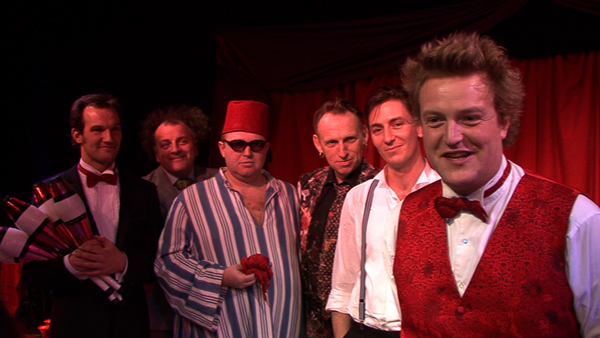
I’m so glad I did. Honestly one of the best shows I’ve ever been to. A true british variety show, with original skills and theatre. So funny, go see it!
Video of the week – Kristian kristof
Kristian Kristof is often sharing great finds on his Facebook page so we thought it was only right to point you in the direction of his own work:
Warming up
Just like athletes or actors, circus performers warm up before a performance. While a warm up may not prevent injury as many think, it can be helpful to refresh the skill set and frame of mind before one steps out on stage.
Having said that, is it a good idea to run your routine in full before your show, should you touch base with the skills or should you do something completely different?
When on a 4 month contract (all the performances were in the same venue), I charted the number of technical mistakes (drops, being behind on cues etc.). For two weeks I did my act on stage before the show, for 2 weeks I did some of the skills in the act before hand, for 2 weeks I warmed up with something completely different and for 2 weeks I did no warm up.
I found despite the warm up method there was negligible difference on my technical performance on stage. It’s hard to be objective as to how well the act was performed but I do feel that the two weeks where I did no warm up were a little harder for me in terms of performing and connecting with the audience. Therefore personally speaking there is little difference in the out come of warming method but it is preferable to do some kind of warm up.
From a phycological point of view I prefer to warm up with a little of the skills I use on stage and then move onto something completely different. For instance in my act I don’t juggle balls so I like warming up with a few short runs of 5 balls, maybe 30-60 seconds. This is enough to relax me, make me think about my posture and enjoy the pattern. I don’t do anything hard as I want to keep drops out of my head and keep my confidence levels up.
I know some artists who like to run their routine in full, others like to run their routine in revers while some like doing each trick 10 times clean. For me this is too much but if it works for you then great. One thing to consider when devising your own warm up methods is where are you going to do this warm up at your gig? I can do mine in a dressing room or in a corridor, anywhere really. It’s worth coming up with a warm up that can fit into a stairwell or other relatively small places that you find backstage as few venues have good warm up facilities.
One specific thing I would recommend is balancing an object on your face, doesn’t mater if you’re a juggler, acrobat, aerialists, actor, dancer or snake charmer. Once learnt, it takes up no room and is very reliable. With in 15 seconds you become still, focused, increased spacial awareness and reminded of your posture.
I would recommend coming up with your warm up plan and then test it out a few times. Get up early, go into your warm up and then do your full routine. If it worked out then great, if not, you either need to change your warm up or make your routine easier.
This is all fairly personal but through planing and testing you can come up with a warm up that will give you the best chances of nailing your perfect show.
Good luck!
The Technique IS the Character
I was talking recently with someone who is working on creating a new juggling act, and they mentioned that they wanted said new act to contain more “character”, and that they wanted to include more stops and pauses: for the purpose of showing that “character”.
Almost as recently, upon introducing myself to a fellow circus performer they asked me what “theme” my juggling act had. My reply of “juggling” left them nonplussed.
Having had to pick my jaw up from the floor on each of these occasions, I realised I could perhaps usefully try (for myself if no-one else) to form my thoughts into some kind of clarity on this matter.
The year is 2011. It was over 30 years ago that nouveau cirque made a clear and, surely at that time, necessary statement about the break they were making from non-nouveau cirque. But I sincerely hope that we are far enough now with the circus arts and their development to understand that we don’t have to justify our time on stage by claiming it to be circus “with theatre”, or “with dance”, or “without horses”. Or “with value added character”. Circus is circus, and it’s practitioners are circus artists.
If we are using the circus arts (circus techniques, as in skills and tricks) to express ourselves, then we owe it to them, and to ourselves, to show them some respect and to create and show work where that technique set is needed. Needed means not added on as a bonus but rather integral to, and defining of, the work. The technique should be a necessity of the performance (and perhaps also the other way round, but that is perhaps a topic for another time).
If technique is integral (which to me is a backbone of circus performance), then technique has a lot of responsibility. It is the major means we have to communicate our intent. I shall repeat that more clearly (and to really stress it, I shall do so by manually re-typing it, rather than using copy and paste): technique is the major tool that we have to communicate our intent.
That doesn’t mean that it should subsume the intent, but that it serves the intent.
If our intention includes the need to create a particular “character” (be that character one of pop-star, ninja, sailor or, dare we even say it, JUGGLER), then I hope it is clear that, although costuming and make-up, or staging and light, are important and valuable factors in our constructs, it is TECHNIQUE that must take the lead. We should innovate in our technique, believe in it, and shouldn’t be scared to trust it to tell an audience more about our intentions and emotional content then any other factor.
After all, love of technique is what drove us in the first place to learn this craft, and I hope that that same love is a factor in keeping us in this crazy, impossible, beautiful, painful, ghastly, inspiring, incredible life that we may call our job.
Innovate your technique: create the right trick for the right moment.
Trust in your tools: and let an audience share that trust.
And always remember: the technique IS the character.
Ten jugglers
Recently I got asked to list ten jugglers that have inspired me. These ten mean a lot to me for a number of reasons.
• BUBA – When I saw this guy first time I was amazed. Clever and funny.
• Aleksandr Koblikov – This young artist is just amazing. I love the footcatches in the video.
• Gregory Popovich – He was one of the first jugglers I ever saw. The video was from a circus, can´t remember which one. There was also an interview where he spoke about the importance of conditioning. Great side summersaults in his devilstickact. (like most russian artists) He inspired me to go for runs, practice acrobatics and to kick from six balls to seven.
• Kris Kremo – I was never interested in juggling with hats, cigar boxes or handbags but what he is doing with the balls is simply amazing in my opinion. And I also find him a great entertainer.
• Mark and Benji – This number rocked my world a bit when I saw a video a friend of mine filmed at a German youthcircusfestival a year or tow before their big hit in Paris. Loved the odd ideas, the music and of course the juggling. I suppose it inspired me and Rod Laver for the act that we used to do as well. Its also one of the only juggling acts that makes my girlfriend Fofo happy.
• Michael Menes – I wanted to be him in the beginning of my career. Not anymore though. But I still like Three round objects.
• W.C Fields – Inventor of stuff.
• Bobby May – He is probably the most inspiring performer on this list. All the stuff he came up with and the little films he made… Really, really great.
• Bernard Kudlak – Formed Cirque Plume and did a fantastic ballbouncingact in one of their early shows.
• Anthony Gatto – I remember when he did 7 clubs for a minute in the gym at the convention in York 2000.
It would be great to hear your coments on this one. Also, it would be great to hear about performers that have inspired you.
//Dav
Anthony Gatto – Bridgestone Commercial
Prop Stands
After my prop building post I thought it might be nice to look at prop stands in the context of juggling routines, they are often over looked but can dramatically change the structure of an act.
I thought it might be interesting to analysis some routines to see what kind of prop stand they use and note some of the positive and negative aspects of their stand. If you know of any interesting examples or points don’t forget to add a comment below.
Before I get too deep on this subject it’s probably best to define what a prop stand is. I’m defining it as an object created for the purpose of holding a performers props, allowing them to quickly or elegantly transition from one prop to another. Fairly simplistic but I think it’s a workable definition.
So first up I’d like to look at Donald Grant’s diabolo act.

I love this act; it’s well choreographed and full of character, one of my favorites. In the act Mr. Grant transitions from using one diabolo to two. His prop stand is either the floor or sometimes an assistant brining on the second diabolo. It works because it’s simple, it doesn’t distract from the performer and gives him a quick transition from one piece to another. The drawback is should you have an act with more props, the stage could become unworkable and if the stage is not level then it could easily cause problems.
Having said that a few months ago Jay Gilligan and Wes Peden released a video called “More Fun Than Visiting a Zoo Volume 2 – Instant Prop Stand” in which they explore the concept of using the props themselves as the prop stands.
The set up required for some of the tricks is slightly mind blowing but besides the practicality it produces some very nice and original work. You can buy the full video download here (and no I’m not on commission!).
Kris Kremo is another favourite of mine so let’s have a look at his work with regards to prop stands.
Kris uses more props than Donald but works around the problem by having his props on a convenient table or ledge usually off stage. This way Kremo avoids having a distracting prop stand on stage, he also doesn’t have to worry about having his prop stand set correctly. The only draw back is he must exit the stage momentarily to change props. However this also helps in the structure of the routine, for a moment the audience doesn’t know if he will return to continue or take his final applause. It’s interesting to note in this fascinating interview with Kris Kremo he mentions his farther, Bela Kremo who taught him much of the act. According to Kris, Bela liked to use a chair as a prop stand because (like the props in his routine) it was an everyday object that the audience was familiar with.
Gandini Juggling, who I occasionally work for, use many different props and have simple methods to store their often large number of props on stage.
For standard small balls they have simple buckets which stop balls rolling about the stage. The only draw back is that it’s difficult for more than 2 performers to access the balls at once. The Gandini glow club stand solution is extremely elegant, the props and stand are displayed to the audience rather then hidden away and are particularly atheistically pleasing. I think this is a great example where the prop stand adds to the routine rather than distracts from it. On a practical note the only downside I know of is that they weigh a fair amount and do not fold down.

Dieto another gentleman juggler that has a particularly interesting prop stand. Parts unfold revealing small characters presenting props, very unusual and well crafted. I like that a visit to the prop stand is as entertaining as the juggling and manipulation (which I also really like). Some people will say it’s too gimmicky but personally I love this act and would love to have a prop stand as equally as eccentric!

The god father of technical club juggling, Alexander Kiss had some amazing tricks and some very impressive props that bordered on the line of prop stands. My favorite of his was a device which fired clubs into the air (he then perform a trick which has become a measuring stick for many of today’s jugglers; 5 club backcrosses). The magical quality in which he is given his clubs makes you question if he is also just some kind of ingenious machine built in one of the circus workshops behind the Iron curtain in the 1950s that surely existed. Given the tricks that he and his sister (Violetta) performed I would not be massively surprised to find out they were both robots.

Evgeni Biljaure (Or Ewgenie/Evgenie Biljaueis depending where you look on the net) is another juggler who pushed the limits of what was thought was possible. 2 ball head bouncing, 5 club forward rolls, 7 rings with a balance, an amazing juggler. In his routine props were thrown to him from all different directions, props flew in from all around the ring. This kept the audience guessing, used the space well and kept the energy of the act up. The only downside to using faceless assistants is you have to trust that the ring boys are paying attention to your act and waiting for their cues, otherwise you might be waiting for that 3rd ball for an awfully long time!

Bert Garden a comedic gentleman juggler, has a automated moving case that appears to interact with him. At one point Garden is even handed a ball from an arm that protrudes from the case in a comical manor. I’d say the main draw back with this particular prop stand is that the performer has to bend over each time to get a new prop. Bending over looks a little unsightly and doesn’t seem to fit well with the character of a gentleman. However I like the idea of the prop stand having a mind of it’s own, it reminds me of ‘The Luggage’ from the marvelous Disk World novels by Terry Pratchett.
More recently Christoph Rummel uses a club firing device in one of his routines. Interesting to have the workings of the device on display, it seems more robotic and less magical, I’m not sure if that’s a good or bad thing.
I’d say there is still so a lot of potential in using prop stands in creative ways but building interesting stands can be tricky. If you’d like to learn more perhaps reading this article about implementing a propstand into a routine written by the brilliant Steven Ragatz over a IJDB is a good place to start.
The Importance of Being Selfish
I have been lucky in recent times to be able to work as a teacher/director in disciplines outside of just juggling. Amongst other projects, a few months ago I lectured on creativity and lead a workshop at a meeting of hand-to-hand acrobats in Stockholm, and even more recently I directed my favourite aerialist Petra Lange’s latest dance/acrobatics act.
And less far from my usual comfort zone, for his last two complete evening show productions, I have been listed on Ken Bardowicks‘ posters as “Magical Advisor”. Part creator, part director, part magician and part spectator. It can, and mostly does, jump from the most crazy brainstorming of impossible sounding effects, to the solving of the most banal of problems. Pulling techniques and methods from classic turn of the century sources, or as new as anything being thought of today, and finding solutions and workarounds to weak-points and logical inconsistencies.
And although it is by definition a work together, I am more than happy to acknowledge the purely selfish advantages that it brings to me.
More than anything in my own work, be it magic or juggling, I strive to create material that I personally would like to see performed. The reason I create is to fill a gap: a gap that should contain that which I want to see. I am certainly not alone with this approach to my art, with a pedigree of such people as the film director Tim Burton, or the juggler Jay Gilligan, to back up this standpoint. At the very least, there will be one happy person when I perform my work (me!). And as I do believe that we (the human race) as people have very similar needs and desires, so there is a reasonable chance that what makes me happy, will also make others happy. My contributions as Magical Advisor, or director to other disciplines within the performing arts, is an obvious extension of this selfish desire.
Through my work with Ken and others, I suddenly have so many more possibilities to see that which I want to see performed! No longer does my own technique set or performance outlets have to limit what I can see on stage! I can suggest ideas, and someone else will do them for me! A killer routine that I would be too lazy to do the set-up for every day? A beautiful effect that I could never build the apparatus for? No problem! And although sometimes the work is more about detailed corrections and choreographies, the excitement of seeing those wonderful effects that otherwise I wouldn’t be able to see is what keeps the excitement present in our continuing working relationship.
In any relationship, compromises are necessary. Sometimes one must back off from purely personal desires or needs. And in this one specifically, it is Ken’s work, the effects, the show, that are the clear priority. Sometimes (but rarely) we search for solutions to something that doesn’t stir me in a particularly emotional manner, but most of the time, what I take is worth at least that which I can give. And sometimes it is good to remember to be selfish.
Aerial Insecurity
Why, upon meeting aerialists, and upon each of us saying who we are and what we do, do they so often follow up with “oh, I am such a bad juggler” / “oh, I could never learn to juggle with more than 2 balls”?
Are they so insecure at basing their jobs on “physicality”, or do they feel that I, as a lowly “non-physical” artist, must feel insecure in their presence?
Props
I am currently in Seattle, USA, doing shows at the Moisture Festival: http://www.moisturefestival.org/
It is thusly named because of the rain… They didn’t lie to me.
In my big collection of VHS tapes back home are held many performers who appeared on the Paul Daniels Magic Show in the 80s and 90s. Two of the most inspirational performers to me from that era, and from those tapes, are Johnny Fox (sword-swallower) and Frank Olivier (juggler).
I doubt I would be doing this job if it weren’t for them. Really.
Last week, I held Johnny Fox’s hand in the curtain call, and last night a slightly drunk Frank Olivier jumped on a pull up bar and wrapped his legs around me.
Give me a moment, I am tearing up a little…
OK, I’m back…
Just before the show with Johnny, I was pacing around as usual, with my clubs in my hands. He asked me if he could check them out. Somehow, I managed to say “no”. Of course, he understood, and watching his prep, he clearly understands rituals and habits, but still…
I hate it when people ask to touch my clubs.
Although not uniquely custom built to my body and needs, ordering a 95mm, standard length, hard bodied, non-wrapped, extra light club in the colour of my choice (probably white) from Renegade gives me a good amount of personal connection to the club. I know the people who build them, and I have visited the small workshop where they are born.
I always do my final backstage warm-up with the clubs that I will use on stage. They need to get focused and ready too. It is their responsibility to make my juggling look good. Their weight keeps me slow and calm, and their solidity gives me one certain thing to keep hold of during my time on stage. Different stages have different heights, different lights, different floors. Even different audiences. But one thing is always the same: the clubs that come on stage with me.
I was working in the Krystallpalast Varieté in Leipzig, Germany, on the night of December 31st, 2003. Just after midnight, a fire broke out on stage. My partner at the time, Ilka Licht, was one of the first to see the flames, and, as audience and artists started to run from the burning theatre, she ran instead in the opposite direction, backstage, to grab our club bag. A little later the two of us and our clubs stood safely in the cold watching the smoking building. It never occurred to us that she perhaps shouldn’t have taken that risk…
Juggling vs. Magic
The first section of this essay (the actual Juggling vs. Magic part) is basically an expansion of a post from the internet newsgroup rec.juggling (if you can’t plagiarise yourself, then who can you?): the original thread is here: http://www.jugglingdb.com/news/thread.php?id=185651&group=1&highlight=juggling%2Cmagic . I feel I am further with my understanding of my viewpoint now, and with my reasons for keeping these elements separate in my own work, and thus it seemed like the right time to revisit this theme.
I will be making use of the phrase “hobby” magician or juggler, and I mean no offense with that. It is simply a useful definition (at least for me) of non-performer. I loved it back in the day when I was a hobby juggler and magician…
———————————-
When I was 11 I bought my first magic book.
When I was 14 a juggling book followed.
I recently spent time (Mid-March 2011) in Rotterdam working with a juggler who is creating a new act combining magic and juggling. And this is something which I have worked on with a couple of different people, and at a couple of different times.
Yet all this time, I have refused to create myself an act which combines these 2 artforms.
I am often asked about the idea of juggling vs. magic, and to begin with, I wonder why this question is so often asked. Why juggling vs. magic? Why not juggling vs. trapeze? Or magic vs. opera? Of course, the connection has always been there historically, starting from the jongleurs of the middle ages; but the fact that this question is often asked I think implies some other things. Firstly, that the “magic” in question is in the direction of manipulation and skill-based magic, and also, that there is perhaps some crossover in the kind of person who appreciates practicing these skills. What I mean is, we are basing this topic on skill-based magic, rather than illusions.
A starting point to me seems to be the question I occasionally hear of “why are there more famous magicians than jugglers?”. Well, the famous magicians of old were famous because of their stage shows. And later, for their TV specials (and television of course enabled magic shows to move away from the big old illusion shows, because even small effects can be shown clearly). Add to this the pure strength of the emotional impact of magic, and that generally one can quickly create more material in a shorter time, and we have a pretty simple answer as to why jugglers are less famous than magicians. And also as to why trapeze artists or dog-trainers are less famous than magicians…
I mentioned emotional impact, and although I love juggling more than magic, I have to say that the emotional content which is possible with magic is something that makes it far stronger and more accessible to an audience. I do believe that the strength of genuine emotional contact through magical bafflement can not be reached by juggling. I would go so far as to say that even acrobats and trapeze artists can reach that better than us jugglers can. All a pretty girl has to do is to fall halfway down a rope for the whole of the audience to gasp and miss a breath. It is incredibly difficult to reach that level with juggling, and I can think of no single act that can consistantly get that kind of reaction with any audience. With magic it is the same: some effects can create that gasp, and others simply leave such a large hole in the audiences senses that they are speechless.
The statement “magicians need an audience, jugglers don’t” has been put forward as a key difference between these arts. But there are many hobby magicians who practice just for themselves, and many performing jugglers who don’t neccesarily enjoy juggling in of itself. Whether you need an audience or not depends on the person and what they want, not on the field. Personally speaking: I was a magician before I was a juggler, but I hated performing magic until more recently. I had fun practicing for myself, not in performing. Juggling, on the other hand, I was performing (and enjoying!) 6 months after learning a 3 ball cascade.
What is certainly true, is that the hobby magician learns about performance, whilst the hobby juggler does not. Good performance skills (even if only in theory) are part of magical learning. And good performance in this case simply means precision and clarity. Even if they never perform, a (good) hobby magician is aware of every detail of his skills. Jugglers are often not. I learnt so much good stagecraft from magic. Basic theatre theory and practice, which one doesn’t learn from reading juggling books or going to juggling meetings. Which leads to misdirection…
I find the whole misdirection arguments (“magicians misdirect, jugglers direct”) misleading. Misdirection is a misnomer. It is historically badly named. It should be called direction. And direction is simply good theatre. When I make my Erdnase top-palm in my Poker act, I am not MISDIRECTING attention from my hands. I am DIRECTING attention to somewhere else. And I am (trying to!) direct attention to one single specific point every moment that I am standing on stage. Whether I am juggling, performing magic, or clapping in the finale, I am trying to get the audience to react to me in a certain way, and to shift their focus because of that. To repeat myself, (hobby) magicians learn this as a matter of course: (hobby) jugglers do not.
So are there any similarities? Apparently yes, if only because of all the people (myself included) who enjoy both fields. The biggest part is probably the skills involved. It is a reasonably special set of people who get off on practicing juggling, close-up magic or stage manipulation (or Rubik’s Cube, dice-stacking, Sport Stacking, yo-yo, kendama etc etc). So there is presumably a mental set-up which is required to do these things well (and which also, presumably, aids in an interest in writing (and reading) boring essays on the subject…).
So, given these differences and similarities: WHY DO I HAVE SUCH A STRONG IMPULSE AGAINST COMBINING THEM IN MY OWN WORK???
My performance work consists basically of my “straight” (non-funny) 6 minute juggling act, to music. And then of about 30 minutes total “funny” speaking material, of which around 20 minutes is magic acts. I have always had that distinction: magic is speaking, juggling is not. Which makes sense for my magic history (close-up was my first love, classically always performed speaking), but not for my juggling (my first performing was comedy street shows). But at some point in my development, it was important for me to make that distinction, perhaps to push myself stronger in the Varieté direction that I love so much.
But still, why not then make a music based act on juggling and magic? Well, firstly, I don’t “need” a second act to music with juggling. If anything, then I should work on my magic act to music (I have had a semi-finished manipulation act for quite some time now). But there must be a more fundamental reason.
I love simplicity. Simple images, simple props, simple statements of intent. Perhaps I am scared that having TWO (oh my God, think of it!) skills on display would be too complicated or confusing. Is he a juggler? Or a magician? Again, not such a strong reason…
Actually, my work in Rotterdam was the first time that I began to understand and imagine a way to combine these two arts. The student managed to make some magic material which was ONLY POSSIBLE because of his juggling technique. So simple, but a breakthrough, at least for me. My problem was revealed to be the logic that was always missing to me. Why juggle three balls, and then have them vanish and reappear? Well, who cares “why”, AS LONG AS THE TECHNIQUE IS RELEVANT!
I feel so stupid that that simple link has for so long eluded me: especially as that thesis is one of the fundamental statements within my performing. I still don’t know why I have put up those walls between my juggling world and my magic world, but slowly I start to tunnel through.
(Cologne, December 2007 / Seattle, March 2011)
 CircusGeeks.co.uk
You must be logged in to post a comment.