Understanding

I am not sure how useful this little essay will be. I have a feeling it should be a Vlog, but that seems like too much effort, in case it simply turns out to be another rant about juggling…

I want to talk about tricks. “Tricks” has almost become a dirty word amongst certain levels of the “modern” circus world. But I am shameless, and am happy to admit that tricks make me happy. If technique defines an emotional state, so can tricks define technique. On a slight sidetrack now, I was thinking earlier of the Christian Slater skateboarding movie from 1989, Gleaming The Cube. Which I loved. What I remember most was being impressed at all the different skating styles he showed (street, vert, freestyle), and how they were shown as being tied to his emotional state (OK, I may not have explicitly thought that at the time). When he was angry, he went out to his backyard and shredded the half-pipe. When he was sad and lonely, out came the freestyle deck. Pretty cool.

Anyway, I want to write about juggling tricks. My example shall be a trick which has become somewhat of a standard over the last ten years or so, although when I started doing it I hadn’t seen it done before. The basic concept is of catching a club by the wrong end, and making a small half-spin throw to the same hand to get it back to the handle (commonly known as an Oh-shit). The small step I made was to have that throw and catch happen blind, behind the back.

Not a ground-breaking idea, but it made me happy. It developed thusly, in 1999 or 2000:

First trick: throw a club behind the back with a single spin, having it remain behind the body. Make the next catch and throw with the hand you just used, then catch the “behind the back” club back in that same hand. The club in question is thrown and caught at the same point in space. Quite easy.

Second trick: make that same “behind the back throw and catch”, but have it happen with no intermediate catches from the hand in question. No peeking, the club should remain unseen by the juggler at all times. Rather hard.

Third trick: the easier version! Change the “behind the back throw and catch” from a single spin to a half spin (an Oh-shit!). This means it barely has to leave the hand, and is therefore very easy to do. As a bonus, it also, I think, looks better. (I later saw Maksim Komaro’s solution to this same problem. He changed the pattern he was using to add time to quickly spot the club, making the single spin variation quite doable. But I still wanted the blind version!)

So, there was the trick. A behind the back thrown and caught Oh-shit. Without getting too much into overly technical details, there are several possibilities of patterns (another dirty word!) for doing this trick. The obvious ones (to a juggler) are called 423 and 522. I chose a hybrid pattern, 52242, to be my default for this trick. The reasons for this I shall get to soon.

I started to perform this trick in my act, and did it at juggling conventions and showed it at workshops. The process to find the trick was very easy and obvious, and no doubt others found it to. It is now a very common “new juggling” trick.

And everyone else I have seen do it does it in one of the obvious patterns: 423 or 522.

I might be overly cynical about it, but I get the impression that most people think of the “trick” being the little half-spin throw, and the pattern that it is done within as a necessary evil: an afterthought, perhaps. Simply a shortcut to get to the “trick”.

As I wrote before, tricks make me happy. And so I want my juggling to show each trick in it’s best possible light. I chose my odd little hybrid pattern because (I believe) it is constructed in a way that brings attention and focus to the (very small) trick that it makes possible. The throwing order of the hands, the relative heights of the throws, the planes the clubs move in, the way that my body and head have to move to allow the pattern: these things bring the focus to the place I want it to be, and so, I hope (and believe) make the tiny little “throw and catch” moment clear, interesting and IMPORTANT to my audience.

The moment we stand on a stage and show our juggling, we must have a complete understanding of what it is we are showing. It is not enough to do some tricks, no matter how happy they make us. Each trick must be understood, selected and, if necessary, added to or pruned in order to give our audience the show we want them to have.

We should understand our tricks, so we can present them in the best way possible.

Clockwork

GOP Varieté Hannover, end of week 5:

(Time zero, 3 hours before show-time)

Arrive at theatre.
Training: 3, 5, 4 clubs.
One hour break in the dressing room (Facebook and other business).
Prepare for pre-show Close-up: brush teeth, style (?) hair, suit on. Two Sharpies in inside right jacket pocket, one lighter and two coins in left jacket pocket, one deck of cards in right jacket pocket, one deck of cards in back right trouser pocket, one lighter plus bent coin in front left trouser pocket, four coins in front right trouser pocket.
Close-up at the tables.
Return backstage, tell the MC that the audience are good and wish him a good show.
Show begins.
Change into backstage clothes, show make-up.
At end of penultimate act before intermission change into costume (suit number two).
Remove clubs from bag.
When last act before intermission starts, apply handcream.
Intermission: nod to the Swedish girls as they leave to continue warming-up on-stage, take their place backstage and begin warm-up.
Warm-up: 3, 4, 5 clubs. Exchange brief words with MC as he passes. Sixty seconds later Ukrainian acrobatic base comes up stairs. Flyer follows two minutes later. Technician will pass by sometime between these events.
After warm-up, place clubs carefully against wall, return to dressing room to remove any sweat and check costume and make-up.
Take clubs and go to side of stage.
Warm-up phase two: 5, 4, 3, 2, 1 clubs.
Check shoes, check socks, check fly, check jacket button.
Wipe hands, collect all clubs.
MC is making the introduction, warm-up phase three: legs, shoulders, feet.
Go on stage, do act.
Bow, leave stage.
Collect off-stage clubs, thank stagehand as he returns the remaining clubs, put clubs back in bag.
Strip upper body.
Change into finale shoes.
Enter drop data into iPad.
Drink water.
Wash upper body, apply cold water to made-up face.
E-mail / Facebook / blog.
When penultimate act begins, get dressed for finale, wash make-up off suit.
As final act ends, go to side of stage and check stability of the two chairs to bring on.
FINALE!

Stories from not very long ago…

Some short stories from an older artist friend…

“In the time that my parents were performing in the Soviet Union, Odin Dankmann (the General Director of the Soviet State Circus) still held favour with Stalin. Later, he was ordered by him to be shot.”

“Each time that we were engaged abroad my father had to visit the Gestapo to receive a visa and permission to travel. The official there meant us all the best as he gave us our final visa in 1944, with a meaningful look and the words: “this is the last time that I can give you these papers.”

“In the early 1960s it was still normal, despite the Berlin Wall, to have musicians from West Berlin playing in the orchestra at the Friedrichstadtpalast. I remember that one such musician was involved with a young lady from the ballet. The lovers spent every moment that they could together. One day the Stasi arrived during a rehearsal and arrested the couple. I do not know exactly what had happened.”

http://twitter.com/#!/CircusGeeks/status/71927643452354561

Manipulation Research Laboratory #3

http://www.shoeboxtour.com/mrl/

Jay Gilligan writes:

“The third and final Manipulation Research Laboratory (MRL) took place in Stockholm, Sweden, on March 22-25, 2010. The first MRL focused on finding the rules of manipulation. During this process the realization came that these rules were actually speaking about composition, which became the theme for MRL #2. MRL #3 combined both previous topics of exploration and zoomed in on composition at the level of single tricks, as well as documenting the process of creation for making tricks.

Every trick has two main parts – not only the pure physical movement and concept, but also what physical object this movement is done with. Objects can then be further described by examining either their shape and form, or by the materials of which they are made.

The main research team consisted of Luke Wilson, Ivar Heckscher, Erik Åberg, Matias Salmenaho, along with myself. The laboratory was joined by three students – Ron Beeri, Patrik Elmnert, and Wes Peden. Ben Richter, a senior member of MRL #1 & 2, also contributed to early discussions of the work.”

http://www.shoeboxtour.com/mrl/

Personal

I think I wrote a while ago that one reason I didn’t start blogging earlier was that I felt it was too personal, too egocentric, and too TMI (TTMI?).

I am in my own bed in Cologne, after a week of shows in Hannover, and have been enjoying a lovely whisky. Which maybe helps me to think about this post.

I got into quite a discussion on the train home with my very close colleague and even closer friend Ken Bardowicks about life expectations. I was thoroughly offended by some things that he said, but luckily we are close enough that I could tell him that. It reminded me though of my opinion that basically all life possibilities and choices can be made to work.

I worked for nearly ten years with the woman who first became my wife, and then in due course my ex-wife. Whilst we were together, many people told us how clear it was in our work that we were a couple, and that only a real couple could have a connection like we had on stage. I always thought that was, to be blunt, bullshit: and indeed, our work in the time of our separation was in no way less “good” than before. What was important on stage was our sharing of a common artistic vocabulary and ability.

To be on tour with ones real life partner/boyfriend/girlfriend/husband/wife clearly has many advantages. And just as many disadvantages. But the point is, it can work. And so can the extreme opposite: I always wonder how colleagues with partners in “regular” jobs manage, but the point is, they do!

The reason I began this post is that my girlfriend had a gig in Hannover this morning: a promotional show for the GOP Varieté where I am working. She arrived at her hotel last night around 3am, and I watched her performance in the city at midday, after which we had a coffee together and I went to my 2:30pm show and she drove the three hours back to her own show in Marburg this evening.

It felt almost like real dating: although we have the same job, it takes us to different places at different times, but when the chance is there to meet up, then fantastic! For sure, it’s not the easiest way to have a relationship, but the point is: all possibilities can work. Rather than having some shallow and slim definition of “life”, we should remember that the world is a rather large place, and most examples of lifestyle that we can imagine are being practiced right now somewhere in the world. All have advantages and disadvantages, but all are possible.

Also, and possibly related, I was rather scared watching Petra hang off a rope, rigged on a hot-air balloon, hanging on a crane, on a windy day…

20110509-025254.jpg

Fourth Wall

Backstage at the GOP Varieté theatre in Hannover, just finished my training and now relaxing for 40 mins or so before getting ready for the first of our two shows today.

One of the major reasons that I love doing Varieté contracts is the stability of the environment. I prefer to know for example exactly how my lights will be, and to trust that the technicians will turn them on and off at the right moment. Ditto for the space, the sound and the ritual. I think this partly comes from the juggler mindset, but can accept that it probably says something deeper about my own psychology too…

“Change ain’t good, Leon”.

For nearly 5 years I performed a set and unchanging act (duo club juggling with Ilka Licht), and my solo juggling act has been set for the last 6 years or so. In that time I have made plenty of new pieces and shows, with magic and with juggling, but I have always held on to my “act as seen” as the centrepiece.

So why did I decide last year that I would retire my juggling act and make a new one to replace it? Well, for many reasons, ranging from “artistic” to “commercial”, but the point is that I am now busily performing an act that I have thus far only done 15 or so times, rather than the hundreds that I would prefer. It’s a good process to go through again! And by the end of the two month run here it shall be without question my “main act”.

For the first time in my life I have an act where I play fourth wall up. It is only for the first 50 seconds or so, but it is totally new to me. I have always made a point in my work of starting a clear dialogue with the audience as soon as I walk on stage, and to start that dialogue whilst being completely internal and alone is something I am learning. It seems to come so naturally to all my acrobat colleagues, but I guess that is why many of them often say that they cannot imagine eg talking on stage, or that to so would be such a major step. It seems an obvious step to me as an extension of the audience contact, but if that contact is other than what I am used to, then of course it seems as foreign as “being alone” on stage is to me.

But it is getting less so every day.

“I don’t enjoy it… (but) it’s a good career”

Just linking this up here, an article about young Las Vegas juggler Ty Tojo (“Fifield”): stepson (and student) of the great Dick Franco.

http://www.lasvegassun.com/news/2011/apr/29/north-las-vegas-teen-world-class-juggler/

What I find of particular note is the following quote:
“I’m proud of it,” Fifield said of his juggling skills. “But I don’t enjoy it. It’s a good career, though.”

Double Dutch

A lot of my work over the last years has been teaching based, and this month found me teaching for the first time at the circus school in Holland.

I mean, at the circus schools in Holland.

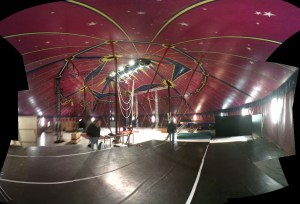
Both Rotterdam and Tilburg now boast circus departments within the auspices of a university organisation. Both offer four year bachelor programmes. Codarts in Rotterdam are about to present their second graduating year, ACaPA in Tilburg their first.

Another difference:

Codarts school hall
Codarts school hall
ACaPA circus tent
ACaPA circus tent

When coming in for a week, I am always torn between wishing to spend the short time available doing strict technique classes, or to rather concentrate on eg choreographical / concept based work. I hope always that I find a balance between these two, but manage always to come away wishing that I’d had more time…

The major difference between the two schools, or rather the one that has the most effect relating to my work at them, is that Codarts has a permanent juggling teacher in the shape of Gregor Kiock. This means that I can trust the students to have, and to keep to, a consistent and strict technique training programme. It also means that my guilty conscience at tweaking people’s technique is made even guiltier…

It feels so good to make tiny physical corrections (hand position, cross point etc) to someone’s pattern and to instantly see an improvement. That work can feel just as creative and valuable, sometimes more so, than seeing the results of a pure conceptual exercise. Hopefully both will make an impression of some kind on my students.

My next stop in the world, after a single and all too brief day at home in Cologne, shall be the GOP Varieté in Hannover, where I shall be for all of May and June. Sometimes my job feels like several different jobs. Which seems like rather a healthy and challenging, if somewhat stressful, position to be in. Come visit me if you happen to be near!

Photos with Photosynth on iPhone

http://twitter.com/#!/CircusGeeks/status/64300179033047040

Normality

I should probably write a “normal” blog entry from time to time, as opposed to soapbox-standing tirades that probably make me sound like I would like to be standing outside your house shouting up at you in the middle of the night.

I am writing this on a train (like most of my contributions so far) on my way to Berlin. I am going to see the lovely Petra, and then we travel on to Gera to spend Easter at my non-legally-bound in-laws.

Easter in the East. Ha ha.

OK, that comment says something about my current mental state, I am sure…

These four days bridge the time between teaching last week at Codarts (a circus school in Holland) and next week at ACaPA (a circus school in Holland). It will be the first time that I visit ACaPA, and so I am excited to see exactly what is going on there, and try to get a feel for what differences exist between these two schools, how they differentiate themselves from each other.

UPDATE: I have painted eggs for the Easter time. Is that normal enough for a blog? I am rather happy with the geek content of them.

http://twitpic.com/photos/cubecheat

Happy Easter (from the East)!

The Technique IS the Character

I was talking recently with someone who is working on creating a new juggling act, and they mentioned that they wanted said new act to contain more “character”, and that they wanted to include more stops and pauses: for the purpose of showing that “character”.

Almost as recently, upon introducing myself to a fellow circus performer they asked me what “theme” my juggling act had. My reply of “juggling” left them nonplussed.

Having had to pick my jaw up from the floor on each of these occasions, I realised I could perhaps usefully try (for myself if no-one else) to form my thoughts into some kind of clarity on this matter.

The year is 2011. It was over 30 years ago that nouveau cirque made a clear and, surely at that time, necessary statement about the break they were making from non-nouveau cirque. But I sincerely hope that we are far enough now with the circus arts and their development to understand that we don’t have to justify our time on stage by claiming it to be circus “with theatre”, or “with dance”, or “without horses”. Or “with value added character”. Circus is circus, and it’s practitioners are circus artists.

If we are using the circus arts (circus techniques, as in skills and tricks) to express ourselves, then we owe it to them, and to ourselves, to show them some respect and to create and show work where that technique set is needed. Needed means not added on as a bonus but rather integral to, and defining of, the work. The technique should be a necessity of the performance (and perhaps also the other way round, but that is perhaps a topic for another time).

If technique is integral (which to me is a backbone of circus performance), then technique has a lot of responsibility. It is the major means we have to communicate our intent. I shall repeat that more clearly (and to really stress it, I shall do so by manually re-typing it, rather than using copy and paste): technique is the major tool that we have to communicate our intent.

That doesn’t mean that it should subsume the intent, but that it serves the intent.

If our intention includes the need to create a particular “character” (be that character one of pop-star, ninja, sailor or, dare we even say it, JUGGLER), then I hope it is clear that, although costuming and make-up, or staging and light, are important and valuable factors in our constructs, it is TECHNIQUE that must take the lead. We should innovate in our technique, believe in it, and shouldn’t be scared to trust it to tell an audience more about our intentions and emotional content then any other factor.

After all, love of technique is what drove us in the first place to learn this craft, and I hope that that same love is a factor in keeping us in this crazy, impossible, beautiful, painful, ghastly, inspiring, incredible life that we may call our job.

Innovate your technique: create the right trick for the right moment.

Trust in your tools: and let an audience share that trust.

And always remember: the technique IS the character.

Too Complicated

Nearly back home after an incredible, exciting, inspiring and stressful 2 weeks of performing at the Moisture Festival in Seattle, USA. 3 ‘planes behind me, now an hour more on the train and a taxi to follow…

iPad plus iPhone internet tethering plus PlainText plus WordPress equals awesome.

I am often surprised by odd compliments. Especially those coming from fellow artists, and especially those that have a form that allow me to simply say “thank you very much”, whilst actually wanting to ask “what does that mean?”. Like “it was nice to see some art”, or “he’s a juggler’s juggler”.

Something that am always ready to reply to with “what does that mean?” however is when jugglers tell me that a particular trick, or sequence, is “too complicated for an audience to understand”. WTF does that mean? It compares to the equally enigmatic yet ridiculous soundbite “they can’t tell the difference if you are juggling 5 or 7”.

Who are these “they” of whom they speak? And why is “their” possible failure to understand an aspect of our performance a reflection on their stupidity, rather than a reflection on our own failure or inability to make ourselves understood?

There are three elements to any play. The play, the actors, and the audience. And the responsibility for success lies with them all. Does that mean we should patronise our audience to the point of stupefaction, reduce them to unknowing vessels, undeserving of our attention and edification? As long as my audience has given me the respect to come and sit in a theatre and watch me perform, then I shall give them respect and, hopefully, provide them with entertainment that also has the possibility to challenge and evoke them.

I shall hold their hands when they need it, but I shall assume them to be smart enough to follow me, and also to lead me to new places within my work.

http://twitter.com/#!/CircusGeeks/status/58125021608030208

The Importance of Being Selfish

I have been lucky in recent times to be able to work as a teacher/director in disciplines outside of just juggling. Amongst other projects, a few months ago I lectured on creativity and lead a workshop at a meeting of hand-to-hand acrobats in Stockholm, and even more recently I directed my favourite aerialist Petra Lange’s latest dance/acrobatics act.

And less far from my usual comfort zone, for his last two complete evening show productions, I have been listed on Ken Bardowicks‘ posters as “Magical Advisor”. Part creator, part director, part magician and part spectator. It can, and mostly does, jump from the most crazy brainstorming of impossible sounding effects, to the solving of the most banal of problems. Pulling techniques and methods from classic turn of the century sources, or as new as anything being thought of today, and finding solutions and workarounds to weak-points and logical inconsistencies.

And although it is by definition a work together, I am more than happy to acknowledge the purely selfish advantages that it brings to me.

More than anything in my own work, be it magic or juggling, I strive to create material that I personally would like to see performed. The reason I create is to fill a gap: a gap that should contain that which I want to see. I am certainly not alone with this approach to my art, with a pedigree of such people as the film director Tim Burton, or the juggler Jay Gilligan, to back up this standpoint. At the very least, there will be one happy person when I perform my work (me!). And as I do believe that we (the human race) as people have very similar needs and desires, so there is a reasonable chance that what makes me happy, will also make others happy. My contributions as Magical Advisor, or director to other disciplines within the performing arts, is an obvious extension of this selfish desire.

Through my work with Ken and others, I suddenly have so many more possibilities to see that which I want to see performed! No longer does my own technique set or performance outlets have to limit what I can see on stage! I can suggest ideas, and someone else will do them for me! A killer routine that I would be too lazy to do the set-up for every day? A beautiful effect that I could never build the apparatus for? No problem! And although sometimes the work is more about detailed corrections and choreographies, the excitement of seeing those wonderful effects that otherwise I wouldn’t be able to see is what keeps the excitement present in our continuing working relationship.

In any relationship, compromises are necessary. Sometimes one must back off from purely personal desires or needs. And in this one specifically, it is Ken’s work, the effects, the show, that are the clear priority. Sometimes (but rarely) we search for solutions to something that doesn’t stir me in a particularly emotional manner, but most of the time, what I take is worth at least that which I can give. And sometimes it is good to remember to be selfish.

http://twitter.com/#!/cubecheat/status/55743767499640832

Aerial Insecurity

Why, upon meeting aerialists, and upon each of us saying who we are and what we do, do they so often follow up with “oh, I am such a bad juggler” / “oh, I could never learn to juggle with more than 2 balls”?

Are they so insecure at basing their jobs on “physicality”, or do they feel that I, as a lowly “non-physical” artist, must feel insecure in their presence?

Props

I am currently in Seattle, USA, doing shows at the Moisture Festival: http://www.moisturefestival.org/

It is thusly named because of the rain… They didn’t lie to me.

In my big collection of VHS tapes back home are held many performers who appeared on the Paul Daniels Magic Show in the 80s and 90s. Two of the most inspirational performers to me from that era, and from those tapes, are Johnny Fox (sword-swallower) and Frank Olivier (juggler).

I doubt I would be doing this job if it weren’t for them. Really.

Last week, I held Johnny Fox’s hand in the curtain call, and last night a slightly drunk Frank Olivier jumped on a pull up bar and wrapped his legs around me.

Give me a moment, I am tearing up a little…

OK, I’m back…

Just before the show with Johnny, I was pacing around as usual, with my clubs in my hands. He asked me if he could check them out. Somehow, I managed to say “no”. Of course, he understood, and watching his prep, he clearly understands rituals and habits, but still…

I hate it when people ask to touch my clubs.

Although not uniquely custom built to my body and needs, ordering a 95mm, standard length, hard bodied, non-wrapped, extra light club in the colour of my choice (probably white) from Renegade gives me a good amount of personal connection to the club. I know the people who build them, and I have visited the small workshop where they are born.

I always do my final backstage warm-up with the clubs that I will use on stage. They need to get focused and ready too. It is their responsibility to make my juggling look good. Their weight keeps me slow and calm, and their solidity gives me one certain thing to keep hold of during my time on stage. Different stages have different heights, different lights, different floors. Even different audiences. But one thing is always the same: the clubs that come on stage with me.

I was working in the Krystallpalast Varieté in Leipzig, Germany, on the night of December 31st, 2003. Just after midnight, a fire broke out on stage. My partner at the time, Ilka Licht, was one of the first to see the flames, and, as audience and artists started to run from the burning theatre, she ran instead in the opposite direction, backstage, to grab our club bag. A little later the two of us and our clubs stood safely in the cold watching the smoking building. It never occurred to us that she perhaps shouldn’t have taken that risk…

http://twitter.com/#!/cubecheat/status/55025807067844608

You know how it is.

American theatrical unions are strange things.

I just arrived at a venue for a tech rehearsal: as arranged I was there 30 mins before the official start time.

The theatre is really beautiful, but a very awkward space for me. Imagine a huge old wonderful theatre auditorium and proscenium arch. Now, dig 10 feet down into the auditorium, and drop in tiered seating all around a central stage area. Have 3 entrance/exit runways going onto the stage, and no clear front or back. As I said, beautiful, but not my perfect habitat.

No problem, I am here early. I will warm up and plan how I will use the space. I ask if I may go on the (empty) stage to do so.

“You may walk around, but you may not juggle until the technicians arrive. Union rules. You know how it is”.

No. No, I do not know how it is…

Here is a video of John Cage performing Water Walk. Sans working radios, because the electricians and sound union couldn’t decide who was allowed to plug them in:

Juggling vs. Magic

The first section of this essay (the actual Juggling vs. Magic part) is basically an expansion of a post from the internet newsgroup rec.juggling (if you can’t plagiarise yourself, then who can you?): the original thread is here: http://www.jugglingdb.com/news/thread.php?id=185651&group=1&highlight=juggling%2Cmagic . I feel I am further with my understanding of my viewpoint now, and with my reasons for keeping these elements separate in my own work, and thus it seemed like the right time to revisit this theme.

I will be making use of the phrase “hobby” magician or juggler, and I mean no offense with that. It is simply a useful definition (at least for me) of non-performer. I loved it back in the day when I was a hobby juggler and magician…
———————————-
When I was 11 I bought my first magic book.

When I was 14 a juggling book followed.

I recently spent time (Mid-March 2011) in Rotterdam working with a juggler who is creating a new act combining magic and juggling. And this is something which I have worked on with a couple of different people, and at a couple of different times.

Yet all this time, I have refused to create myself an act which combines these 2 artforms.

I am often asked about the idea of juggling vs. magic, and to begin with, I wonder why this question is so often asked. Why juggling vs. magic? Why not juggling vs. trapeze? Or magic vs. opera? Of course, the connection has always been there historically, starting from the jongleurs of the middle ages; but the fact that this question is often asked I think implies some other things. Firstly, that the “magic” in question is in the direction of manipulation and skill-based magic, and also, that there is perhaps some crossover in the kind of person who appreciates practicing these skills. What I mean is, we are basing this topic on skill-based magic, rather than illusions.

A starting point to me seems to be the question I occasionally hear of “why are there more famous magicians than jugglers?”. Well, the famous magicians of old were famous because of their stage shows. And later, for their TV specials (and television of course enabled magic shows to move away from the big old illusion shows, because even small effects can be shown clearly). Add to this the pure strength of the emotional impact of magic, and that generally one can quickly create more material in a shorter time, and we have a pretty simple answer as to why jugglers are less famous than magicians. And also as to why trapeze artists or dog-trainers are less famous than magicians…

I mentioned emotional impact, and although I love juggling more than magic, I have to say that the emotional content which is possible with magic is something that makes it far stronger and more accessible to an audience. I do believe that the strength of genuine emotional contact through magical bafflement can not be reached by juggling. I would go so far as to say that even acrobats and trapeze artists can reach that better than us jugglers can. All a pretty girl has to do is to fall halfway down a rope for the whole of the audience to gasp and miss a breath. It is incredibly difficult to reach that level with juggling, and I can think of no single act that can consistantly get that kind of reaction with any audience. With magic it is the same: some effects can create that gasp, and others simply leave such a large hole in the audiences senses that they are speechless.

The statement “magicians need an audience, jugglers don’t” has been put forward as a key difference between these arts. But there are many hobby magicians who practice just for themselves, and many performing jugglers who don’t neccesarily enjoy juggling in of itself. Whether you need an audience or not depends on the person and what they want, not on the field. Personally speaking: I was a magician before I was a juggler, but I hated performing magic until more recently. I had fun practicing for myself, not in performing. Juggling, on the other hand, I was performing (and enjoying!) 6 months after learning a 3 ball cascade.

What is certainly true, is that the hobby magician learns about performance, whilst the hobby juggler does not. Good performance skills (even if only in theory) are part of magical learning. And good performance in this case simply means precision and clarity. Even if they never perform, a (good) hobby magician is aware of every detail of his skills. Jugglers are often not. I learnt so much good stagecraft from magic. Basic theatre theory and practice, which one doesn’t learn from reading juggling books or going to juggling meetings. Which leads to misdirection…

I find the whole misdirection arguments (“magicians misdirect, jugglers direct”) misleading. Misdirection is a misnomer. It is historically badly named. It should be called direction. And direction is simply good theatre. When I make my Erdnase top-palm in my Poker act, I am not MISDIRECTING attention from my hands. I am DIRECTING attention to somewhere else. And I am (trying to!) direct attention to one single specific point every moment that I am standing on stage. Whether I am juggling, performing magic, or clapping in the finale, I am trying to get the audience to react to me in a certain way, and to shift their focus because of that. To repeat myself, (hobby) magicians learn this as a matter of course: (hobby) jugglers do not.

So are there any similarities? Apparently yes, if only because of all the people (myself included) who enjoy both fields. The biggest part is probably the skills involved. It is a reasonably special set of people who get off on practicing juggling, close-up magic or stage manipulation (or Rubik’s Cube, dice-stacking, Sport Stacking, yo-yo, kendama etc etc). So there is presumably a mental set-up which is required to do these things well (and which also, presumably, aids in an interest in writing (and reading) boring essays on the subject…).

So, given these differences and similarities: WHY DO I HAVE SUCH A STRONG IMPULSE AGAINST COMBINING THEM IN MY OWN WORK???

My performance work consists basically of my “straight” (non-funny) 6 minute juggling act, to music. And then of about 30 minutes total “funny” speaking material, of which around 20 minutes is magic acts. I have always had that distinction: magic is speaking, juggling is not. Which makes sense for my magic history (close-up was my first love, classically always performed speaking), but not for my juggling (my first performing was comedy street shows). But at some point in my development, it was important for me to make that distinction, perhaps to push myself stronger in the Varieté direction that I love so much.

But still, why not then make a music based act on juggling and magic? Well, firstly, I don’t “need” a second act to music with juggling. If anything, then I should work on my magic act to music (I have had a semi-finished manipulation act for quite some time now). But there must be a more fundamental reason.

I love simplicity. Simple images, simple props, simple statements of intent. Perhaps I am scared that having TWO (oh my God, think of it!) skills on display would be too complicated or confusing. Is he a juggler? Or a magician? Again, not such a strong reason…

Actually, my work in Rotterdam was the first time that I began to understand and imagine a way to combine these two arts. The student managed to make some magic material which was ONLY POSSIBLE because of his juggling technique. So simple, but a breakthrough, at least for me. My problem was revealed to be the logic that was always missing to me. Why juggle three balls, and then have them vanish and reappear? Well, who cares “why”, AS LONG AS THE TECHNIQUE IS RELEVANT!

I feel so stupid that that simple link has for so long eluded me: especially as that thesis is one of the fundamental statements within my performing. I still don’t know why I have put up those walls between my juggling world and my magic world, but slowly I start to tunnel through.

(Cologne, December 2007 / Seattle, March 2011)

Housekeeping

I just googled “first blog”, and didn’t find anything to help me out. So, I guess I am on my own…

Except I am not! I was always wary of blogging, partly because I felt it was too egocentric (perhaps a strange worry for a performer to have), and partly because I was concerned with having enough material to keep it up to date. Well, with this new blog collective (a blogollective?) those pressures are gone, and I can, hopefully, write some stuff without too much fear.

A quick housekeeping of the last 4 weeks:

i. 3 days in Barcelona: working as “outside eye” (outside eye is the new directing!) for circus company “eia”.
ii. Berlin: social visit (and a killer poker hand), training.
iii. 5 days in Rotterdam: teaching at the “codarts” circus school (http://www.codarts.nl/01_home_en/04_circ/index.php).
iv. Cologne (HOME!!!): rehearsing magic acts with Ken Bardowicks in preparation for our month together in GOP Hannover in May. Because we won’t see each other again until that time…
v. Berlin: social visit, plus attending a lecture by Erik Åberg on Paul Cinquevalli, and watching Wintergarten show (Paul Ponce!).
vi. 2 days in Bad Pyrmont: visiting the retired (on three separate occasions) juggler Bob Bramson (http://www.juggling.org/fame/bramson/).
vii. Now in Seattle, USA, for the Moisture Festival (http://www.moisturefestival.org/). Sitting in a strange kitchen, watching my replacement iPhone sync, wishing I had shows before Thursday…

OK, so I guess I shouldn’t worry about lack of themes to write about in the coming weeks.

More shall follow!