I’ve recently completed another Lab:time project, this time looking at the use of a Kinect camera, video projection and basic juggling. Thanks to Circus Space, Howie and Jon for making it possible.
Here’s some of the results…
Artistic adventure by Arron Sparks
I’ve recently completed another Lab:time project, this time looking at the use of a Kinect camera, video projection and basic juggling. Thanks to Circus Space, Howie and Jon for making it possible.
Here’s some of the results…
Circus Space graduate Andy Puddicome of Headspace delivers a TED talk on meditation.
I have to be honest – I’m a bit of a nerd when it comes to ‘juggling with a message’ style pieces. One of my guilty pleasures.
The Robots are coming…
I had another day in the Creation Studio at circus space which I used to work on some technique for the opening of the show.
You may have noticed that this blog has been updated a little sparsely over the last few months, namely because over the summer most circus artists are (hopefully) manic with work and lack a little of the time and energy needed to concentrate on a blog. Unfortunately this is not the sole reason.
Luke Wilson, known online as Cubecheat (referring to his love of the Rubik’s Cube and cheating/magic) was diagnosed with cancer of the oesophagus at the start of the summer. Throughout the summer he underwent treatment but ultimately lost his battle with cancer and past away today.
Luke was a close friend and I have many fond memories of time spent with him but I think I’ll save them for another place and time. In this post I’d like to remember his amazing teaching.

In 2003 at the British Juggling Convention in Brighton I watched a workshop on modern club juggling. There were many great jugglers sitting and watching a skinny, charismatic, excited man explain juggling detail and variation in his already slightly odd british-german accent. He explained ideas and processes in such a brilliantly logical way that it was both beautiful and clear. I asked Guy Heathcote who the man was and he informed me it was a gentleman by the name of Luke Wilson.
Years later, when on the degree at Circus Space I was lucky enough to experience Luke’s teaching first hand. Everything about his approach to teaching and learning was perfect. He had lessons planned down to the minute, almost second. He would literally give you a task for 6 minutes and 45 seconds and then onto the next with 1 minute and 35 of thinking time. Always in a tight fitting t-shirt, watch around the right front belt loop of his jeans (he claimed it was because he didn’t like to juggle with a watch on his wrist but I suspect it was because his wrists were to thin to keep a watch on! Always in jeans because he found them best for kickups, an area of juggling which Luke excelled at. You can view a tutorial we made together on the triplex kickup here, it gives a great insight into the effort and detail Luke went to in anything he did).
Luke had tried and tested methods and tasks but also experimented with new ideas and exercises in class. His classes had a brilliant combination of building up confidence in technique, as well as pushing creativity using defined parameters and matrixes. Overall pushing your understanding of what juggling is and could be.
I’ll never forget having to do 3 ball penguins whilst being asked what the capital of capital of Chile is, what’s six times seven and being poked in the back all at the same time. Or the sequence 1,12,123,23,3,31,312,12,2,23,231,31,1
Lukes thoughts on juggling, circus and art in general massively influenced the way I think and approach work, when I shared a flat with him for 3 months we would often stay up till early morning discussing and debating our views on circus and juggling. He had very clear thoughts on what circus and juggling are and how to define them. Not believing in the relevance of the ‘contemporary vs traditional’ debate which seemed to be so important to some in the 80s and 90s and even today. Luke viewed and defined work as good or bad, original or ripoff, ethical or not.
His views on progressive steps forward for the art form were clear, using the internet to share work and ideas (which included some magnificent posts on this very blog), constantly creating new aesthetics, drama, performance and ultimately tricks.
Constantly pushing himself, seeking out new inspiration and ideas, Luke taught at juggling conventions and circus school all over the world, inspiring 1000s of jugglers. Competing in international circus competitions, performing in sold-out theaters, sharing his art with the world. Living the dream.
Despite Luke coming from Portsmouth and myself coming from Southampton, we always had a great rapport which turned into a close friendship over the years, we shared many of the same interests and passions. When I was in school we would often joke that I was his Padawan learner. I suppose it would only be fitting to include…
There’s so much more I could say about his teaching, never mind his performing or his friendship but it can wait.
For now I need to be still and sad, a friend is gone forever.
I’m currently flat hunting, don’t worry I’m not going to turn the blog into an advertisement platform for my personal life (although I’m looking for a relaxed, quiet flat share in Hackney, if you know anywhere email me!). Viewing a couple of flats and then going through the process of explaining ‘what I do for a living’ to my would-be flatmates has made me think.
In the Dreaded Question I ranted about the boring conversation that is explaining to someone what I do. For the most part I stand by that post, sure it’s a self indulgent position to take but for the most part it’s true. Having the same egotistical conversation over and over agin gets a bit dull (at least for me).
So having to explain to potential flat mates what I do is not my idea of fun but unfortunately at the moment I have to go through it. The other day I must admit I did pause for thought when I was asked, “What did you do yesterday, on the weekend and one month ago?”.
I had to explain that, one month ago I was juggling giant apples in front of 80,000 spectators and millions of viewers around the globe watching the opening ceremony of the Paralympics. Last weekend I went to Portugal and spent most of my time running, eating and relaxing by the pool which was interjected by the occasional show in a beautiful theatre. Yesterday I eventually got up at 9:30 went for a run, had a leisurely breakfast, did some web work/reading, had coffee (it’s a new experience for me) and then went for a few hours juggling and workout. Finishing my days ‘work’ with a book and a quiet pint in my local.
It would be disingenuous to claim that the above answers were an average day but the fact that more than a few have been like that makes me think, I’m super lucky and it can’t last forever…. Best enjoy it while I can!
Being a circus artist can be the best, it’s good to remind yourself of that.
But it’s also wise to remind yourself of harsh reality, moving sucks.
A little while back I had an email from an outfit called “somewhereto_” informing me of an online video competition for 16-25 year olds tied in with the Cultural Olympiad. I wrote back telling them that I hadn’t been 16-25 since the Atlanta Olympics of 1996 but apparently they only wanted me to Tweet about it.
Well, Tweet about it I did and it came to the attention of Unicyclist and Juggler Sam Goodburn who is now in the final 10!
This run-down of the finalists also features juggler Lee Tinnion. Here are the entry videos of both Sam and Lee…
…and somewhereto_’s website…
Over the last couple of months I’ve been touring with Gandini Juggling. I decided to document my travels a little, to give a feel for what it’s been like. The videos not so juggling focused but might be interesting for any circus artists, even if your not a massive juggling fan…
Photos and video all filmed on a iPhone 4S and edited in iMovie for iPad. I like Apples.
The following short, somewhat disjointed, essay is culled from my notes for a lecture I presented at a Duo-Acrobatics Symposium in Stockholm a couple of years ago. I was delighted to find that almost all that I spoke about turned out to be at least as applicable to that field as it was in my own experience within juggling. And of course many new and duo-acro specific concepts and ideas arose and were discussed. Special thanks to Celso and Francesca for organising that meeting: the circus world needs more geeks like them!
Special thanks also to Jay Gilligan, Ben Richter and Erik Åberg. It was the several-year spanning Manipulation Research Laboratories that helped me clarify my own thoughts somewhat on all these themes.
And the process is ongoing, and the research continues and changes each day anew.
Luke Wilson: Cologne, 23.06.2012
—–
“There is no such thing as a failed experiment, only experiments with unexpected outcomes.”
Richard Buckminster Fuller.
Jugglers tend to think a lot about juggling.
Why is that? For one thing, it is simply a huge scene, consisting in large part of many hobbyists with time on their hands. There were over 6000 jugglers in attendance at the 31st European Juggling Convention in 2008 (Karlsruhe, Germany). Many people in this scene are of a mathematical or scientific bent, which has led to the fast development of that particular side of juggling. In addition, we jugglers have less physical responsibility than other disciplines. We can train longer. We don’t need to spend so much time warming up, building muscle, or at the physio. So we have more time and energy to invest in other aspects of the work.
Our theme now is research. And there are two things that we can research in circus (be it within juggling, acro, aerial, lion taming, etc…). We can research tricks (easy and fun), and we can research what the tricks are good for (hard and fun).
In other words, we can make new tricks, and we can make new applications for tricks.
Application is always and only to create an emotional reaction in the audience. Whether that reaction is amazement and applause, or tenderness and tears. Aesthetic or awkward.
This process feeds back in on itself. We can make tricks that are better for specific things, thus improving our success rate at conjuring applause or tears. Or, coming from the other direction, we can first find out what the trick is good for and exploit that knowledge. This may also help define what the discipline as a whole in itself is good for.
There are three aspects to the work, and once we have defined them we can begin to plan the research. This often leads to many questions, but perhaps not to many answers. Which is just how I like my work (or any creative work) to be.
1. PHYSICAL: inc. new tricks and performance / theatrical aspects (“theatre” being used in its loosest possible sense).
2. MENTAL: inc. what the trick is good for, the actual internal moment of execution, and also the “why?” of what we are doing.
3. SCIENTIFIC: inc. the research aspects of our work (and most of the questions that we will find!).
All the work we do is research: every hour in the gym and every minute on the stage. But often we either see it as long term and unfocused, or we do not even notice it as research, simply viewing it as part of the organic training process. So a target we can set ourselves is to be more efficient with this ongoing and ever-present research. We do all the work anyway, but perhaps we can compress and clarify it.
To break down the three aspects more clearly:
1. PHYSICAL:
What are the physical elements of the work?
At least (but maybe not exclusively) the following:
i. Body
ii. Prop
iii. Environment
2. MENTAL:
What are the mental elements of the work?
For example:
In training / on stage? Differences and similarities?
What is special about the skill (props, people, space etc)?
Why that particular discipline?
What is the discipline itself particularly good for?
WDYDWYD? A very zeitgeisty concept: Why Do You Do What You Do?
Why circus? Originally perhaps it was to show what could be. Maybe now it serves to show what is? Almost the exact opposite development of most (visual) arts!
3. SCIENTIFIC:
What can we do about these factors?
Research preparation:
1. Identify the question
2. Define the elements
3. Design the experiment
Research application:
1. Perform the experiment
2. Explore/define the findings
I believe in fast creation: set the experiment, and take no more than 5-15 minutes to execute it / explore the identified concepts.
We must learn to trust our opinion of what is “good”. By taking fast decisions of artistic content or technique, we practice and reinforce trust in ourselves.
—–
There was a time when the Twin Towers tight wire walk was an insider circus story, forgotten by New York and the rest of the world. Then Man on a Wire was released and the world listened, Petit back in fashion.
In this video Petit condenses his solo show to a 18min Ted talk.
*Warning* the juggling is a little painful….
A few days ago I performed with Gandini Juggling in Bergamo, home to some of the best pizza in the world, inventor of Stracciatella ice-cream and the resting place of one of the greatest and most influential jugglers of all time, Enrico Rastelli.
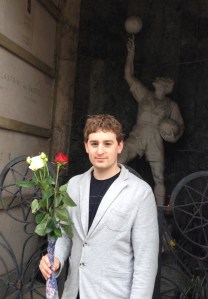
Even though it was only a short trip to Italy we managed to fit in a visit to Rastelli’s grave, a first for me and something I’ve wanted to do for a long time.
As an atheist it felt a little odd to wonder through a grave yard so heavily entrenched in religious symbols. But it was a fitting time and location to reflect on Rastelli’s achievements. While I don’t believe his spirit was looking down on us as we placed the flowers by his feet I’d like to think that if Rastelli were alive then he’d appreciate the gesture.
It was nice to know I was treading in the footsteps of other jugglers who had been to the grave before me. It also reminded me that I really must get round to visiting Cinquevalli‘s grave in South London.
Perhaps as jugglers we care more about pioneers of our art than other circus performers or perhaps we’re just more pompous. I’ve never heard of aerialists or acrobats visiting the grave of someone who pushed their particular discipline, but I could easily be ignorant of the facts. I hope so.
If you’ve ever visited the grave of a famous circus performer or proprietor I’d love to know more, leave a comment below.What a great way to start May…
Thanks to Jon Udry for pointing this one out to me. Anyone fancy doing a translation? Juggling starts at 16:38. Enjoy!
And if you don’t know who he is then (where have you been?!)…
Practice System 3: Completing Halves
Explanation
Completing Halves is a system that, like Five Lives, is also set as a game. Similar to Five Lives, it is designed to work on solidifying one pattern. The advantage to this system is that it can last as long as you want it to last. If you only have 5 minutes, it can last five minutes. Likewise, if you want to train your one trick for an hour, then this could also work for you. This system is rough and ready to go: simple and effective.
Example
Below is an example of Completing Halves using 5 ring pancakes:
1. Make and attempt at your longest run with 5 ring pancakes. Let’s say you get 25 catches when you drop.
2. Half the amount to get 12.5, which is rounded up to 13.
3. You know have three attempts to get 13 catches clean.
4. If you achieve this within your three attempts, then return to step 1, constantly trying to beat your personal best. If you do not manage to get your 13 catches clean within three attempts, then half it again to get 6.5, rounded up to 7, and repeat the process again.
This is a very simple system, yet I feel it is very effective. I personally enjoy the fact that it is so simple, and isn’t time dependant.
I hope you enjoy it, and I would very much appreciate any thoughts, feedback and questions that you may have on the subject. Have fun!
Practice System 2: Five Lives
Explanation
Five Lives is a system that I came up with which is specifically designed for solidifying patterns. Unlike the pyramid system, the amount of throws and catches can change, depending on your skill level that day. An advantage about this system over the pyramid system, is that you cannot fail. Another advantage about this system is that it is quick to complete. I personally find this very useful as I sometimes have to train in limited space facilities. This means that I could just have 20 or 30 minutes spare before I have to move space. This system is perfect for just that situation.
Example
As this is set as a short game, you start with fives lives. Every time a level is not achieved, you go back to the previous level and loos a life. Below is an example of a standard game of Five Lives with 7 balls.
First you set your levels.
7 throws (a flash) = level 1
10 throws = level 2
20 throws = level 3
30 throws = level 4
40 throws = level 5
50 throws = level 6
Etc etc.
Now, you start on level 1. As it is level 1, you have 1 attempt to get your target. If you fail, you loose a life. If you succeed, move onto level 2. Now you are on level 2, you have 2 attempts to achieve your target. If you fail, go back one level to level 1 and loose a life. If you succeed, move onto level 3. This sequence continues until you eventually run out of lives. Take note of your highest level and see if you can beat it next time.
This system can also work hand in hand with the Pyramid System (for explanation of Pyramid System, please see previous article). Once you have died (in the game), remember your highest achievement of that round. Make this the top of your Pyramid System for that day and create your pyramid from the top working down.
Example
My highest achievement in Five Lives today was 30 catches of 7 balls. My pyramid for today could look like this:
30 catches x 1
20 catches x 2
15 catches x 3
10 catches x 4
7 catches x 5
I hope that you have as much fun with this system as I have. If you have any questions or comments then please do leave them below. Thank-you.
I have always liked kick-up tricks with clubs, and have over the years somewhat specialised in them to a greater or lesser degree, including teaching workshops at juggling conventions specifically about that particular trick, and releasing a couple of videos onto the internets based around some of the variations possible. This has lead to me being perhaps somewhat known in the juggling community for this particular trick.
Yesterday I performed my club juggling act at an event held at a circus institution: a press conference type show with circus students and teachers, and various city officials in attendance.
It wasn’t my best show, but I did my job reasonably well, and was, as far as I could tell, well received by all. After the show, one of the jugglers (who had mentioned already that he had done one of my above mentioned workshops some years ago, and was also very interested in kick-ups himself) complimented me on my act, and then followed that up with: “but you don’t do many kick-ups in your act.”
I agreed with him, and talked a little about how I have been doing less kick-ups in general in recent years, due to the wear that they put on the knees and ankles, and the worsening injuries that that in turn entails.
Whilst this is true, and there are specific kick-up variations that I no longer practice for that reason, I have now thought a little more about his statement, and what it could mean.
For the fact of the matter is, that in the act I performed, which lead directly to the comment of “you don’t do many kick-ups in your act”, I do 5 different kick-up variations, for a total of 43 individual kick-ups in a 6 minute act.
That actually seems like quite a lot of kick-ups!
Is it me? Do I think I’m doing a lot and I’m not really? Perhaps, but no-one has ever said to me before that “it’s not very many kick-ups.” Quite the opposite, in fact: audience members commenting specifically on the kick-ups (rather than the absence thereof) is a rather common occurrence. But to be clear now, I refer now to non-juggler audience members.
I don’t know how possible it ever is for us to put ourselves truly in the position of the audience, to overcome our preconceptions of technique, to enter into the mindset of the outsider. And as I have surely written before, the responsibility to mould that mindset rests strongly with us as performers. But we have to first be clear ourselves as to what we are communicating.
A lot of modern/contemporary/new-school/creative/manipulation-based juggling is based around non-repeating patterns. About short sequences, single throws and rapid changes. And in some ways, I find that to be a shame. Only variation and repetition can lead to images and recognition, and I consider such things to be important aspects of our juggling reality.
Perhaps my 5 kick-up variations are too few? Or the repeating patterns too many? But too few for who, and too many based on what criteria, exactly?
How many variations on a theme are too much? When does repetition cross the line from boring pattern to strong image (and back again)? As a juggler, can I ever truly “see” my juggling from the outside?
And how do I know how many kick-ups is enough?
In the ever growing world of juggling, people are improving, at different rates, all over the world. As the saying goes, practice makes perfect. The thing that surprises me is that a lot of jugglers are happy to spend hours practicing their hobby, but do not train in a structured and organised manner. I am constantly surprised at people who arrive at the training space, completely unaware of what they intend to practice and how to do it. I am however impressed at the increase of skill made by people with good practice discipline as opposed to those with no or bad practice structure.
As juggling is a huge part of my life, I have spent time trying to find the most efficient way to practice. I understand that not everyone likes to practice in the same way, and that some systems will suit some people more than others, but I have seen some people slog away at a trick for years with no progress, and I am shocked that they haven’t tried to find the reason why. I firmly believe that if you find a practice system that is good for you, then you shouldn’t strictly only stick to that chosen system. I feel it is important to mix things up, try other practice structures and challenge yourself.
I am not the creator of these systems. Some of the systems I have fused with others to develop them in ways that I feel make them stronger. I have also, taken inspiration from some systems, to develop others in ways that are more suitable for me. I’m not claiming that all of these systems are going to work for you.
These methods are starting points for you to test for yourself and see if:
I’d be interested to hear about your opinions, experiences and own training methods and how they compare to mine so please leave any comments or feedback below.
Practice system 1: Pyramid system
Explanation
The Pyramid system is a common and efficient juggling system. Though at times it can be tedious to execute, if you are dedicated to it, you WILL get results. This system is suited mostly to patterns as opposed to tricks. The main goal of this system is to solidify patterns to a consistent level.
Example: 5 clubs
Above is a pretty classic example of a Pyramid system. Obviously the Pyramid will be altered depending on one’s level. You must complete the first layer, in this case the flash x 10, before you proceed to the next level, and so on.
Creating your Pyramid
In order to begin this splendid exercise, you first need to create your perfect Pyramid. I am sure there are many ways to do this, but here is the method that I would use if I was creating a Pyramid for 7 balls.
Now that that is my Pyramid designed, I would now have to execute it. Starting at the bottom and working my way up to the top. In doing this I would take regular short breaks (maximum 1 minute) every 5 minutes. If I do not achieve my Pyramid that day, then that is ok. It’s either too hard for me, or I’m just having a bad day. Give yourself a time limit. If your Pyramid isn’t complete in say 30 minutes, then admit defeat and try again tomorrow.
I hope that this practice method helps in someway. If there are any questions then please email me at jon.udry@gmail.com
Have fun!
Jugglers prepare for depression/inspiration (depending on your philosophical out look on life), Wes Peden has released his most recent pay for view video digital download, entitled ‘Synthetic’. And it’s epic.
I should probably write a little more on the contents but I’m not going to bother, you all know the deal. If Wes puts 18 months into a project you know it’s going be worth €15!
Buy ‘Synthetic’ here!
I guess if you really need to know more then have a read of this blurb by Wes…
Synthetic is a film displaying the new work of Wes Peden. The material was inspired, in a concrete way, by the strength of each prop and how to best take advantage of these qualities. The general aesthetic of the juggling was particularly influences by asymmetry, clarity, and trick shape.
The video is 45 minutes long and comes with an additional 25 minutes of bonus tricks and remixes. inside you will find 3 club slapping sequences, the coolest 5 ball pirouette Wes has ever done, 25 new ring patterns, a German 6 ball piece, 3 balls and a sweater, THE THROWING AWAY SECTION, the holy club/cuphead/ball part, site specific head rolls, flipping forehead balances, the 2012 five club routine, and so very much many more!
Right now I am sitting in the backseat of a small van / large car: sandwiched comfortably between a yoga teacher and an aerialist. In the front seats are a burlesque performer and, driving, one of our two producers. We are en route to our second venue as part of the Cwtch Cabaret tour in Wales.
www.cwtchcabaret.co.uk
But I want to write now not about touring in the UK (which is a great and wonderful novelty for me!), but about a project which shows once more that jugglers are the geekiest of the circus community.
Earlier this month I was in Berlin for a week, participating in the first Juggling Teachers Meeting, held at the Berlin Juggling Center. Arranged by the centres owner, Alan Blim (the original founder of Berlin’s Juggling Katakomben), this five day workshop was supported by a European initiative for teaching, and had participants from Hungary, the Czech Republic, the UK, Italy, Spain, and of course Germany.
Berlin Juggling Center
So in all we had around a dozen students, and four teachers completed the group: myself, Alan Blim, Marco Paoletti, and Tim Roberts (long-time juggling teacher at the Chalôns school, now head of Higher Education at the Circus Space in London, and president of FEDEC).
Each of us was to teach a day (and to participate as students in the other days), and a target of the week was not only to teach our usual workshops or themes, but also to go deeper into the actual teaching theory behind our work. Each teacher had their own style and manner of course, which also meant that different teachers went at different levels, and in differing depths, into the theoretical aspects behind their teaching.
It became clear by the third day that teaching juggling in general can be divided into two large and different themes: long-term teaching (such as at a professional circus school, with the same students over a period of years), and short-term (like an hour workshop at a juggling convention). Knowing the context that the teaching is happening in informs the content and the detail of the work that is appropriate. Long-term teaching allows more personal research, and the teacher-student relationship can be more equal, with the teacher taking on something of a professor or mentor-like role. In short-term teaching, quicker results are usually desired by the students, and it can be more important to place focus on quick results – cool tricks or simple sequences.
Each of the four teachers material and teaching styles were very different from each other, but common themes showed themselves each days: suggesting that there is some common or shared vocabulary amongst us all. Building a strong foundation of technique and content, creating neutral space for new creation, exploring existing elements as deeply as possible, and noticing (and then breaking) habits we have formed.
Another major topic of discussion was a theme which I have talked about in previous blogs here: the reasons for, and the consequences of, the lack of permanent juggling teachers in comparison to those of other disciplines. As I have also postulated, I believe this is part of the reason for jugglers, historically speaking, pushing further creatively than other artists. But that has always seemed to be an accident of the situation (caused by students having a multitude of visiting, performing teachers), rather than the schools explicitly choosing to provide teaching in that manner.
The desire was always to create something more tangible from the weeks research, and through Tim’s involvement came the decision to write a juggling teachers manual for FEDEC. FEDEC has an ongoing project to create training manuals (free to download from the FEDEC website) for the circus disciplines, to promote exchange between the schools and a good level of teaching across all subjects. There are ten “chapters” so far, and two further (single wheel and straps) already in production. They start with the most basic of technique and preparatory work, before moving onto more advanced material. It became clear that the juggling manual doesn’t need low-level teaching material (the juggling students at the professional circus schools already enter with a high technique level), and so the focus shall be more directly centred on the artistic and theoretical aspects of the work.
www.fedec.eu
Perhaps that approach can then feed back into the other disciplines, just as we jugglers can learn from them. It is also hoped that the work that was begun over the week can be continued and added to: to arrange another meeting, perhaps in London, with a greater mix of teachers with a greater range of experience and styles. Although the week was inspiring and felt very important, it also felt very much like a first step – a step towards a bigger and clearer project.
Warning: This post is a bit of an ego boost, sorry!
I don’t think I’ve ever subscribed to the “I’ve just flashed X number of objects” of approach to juggling. I’ve never set up a camera and spent 35mins trying one trick that’s probably too hard for me, I did today…
When I started juggling (10 or so years ago) juggling 7 clubs was a big deal. Very few could even blag it and even fewer performed it consistently on stage (this hasn’t changed yet). A well known juggling book* has this to say about The Seven Club Cascade, “…it is highly unlikely the more than one or two readers will ever have the actual experience of driving this pattern”. Funny how such statements date so quickly.
The love it or hate it the WJF should be partly credited to the rise of more 7 club jugglers.
And this makes you wonder what’s possible….
*Guess the juggling book
 CircusGeeks.co.uk
You must be logged in to post a comment.