Moving

I’m currently flat hunting, don’t worry I’m not going to turn the blog into an advertisement platform for my personal life (although I’m looking for a relaxed, quiet flat share in Hackney, if you know anywhere email me!). Viewing a couple of flats and then going through the process of explaining ‘what I do for a living’ to my would-be flatmates has made me think.

In the Dreaded Question I ranted about the boring conversation that is explaining to someone what I do. For the most part I stand by that post, sure it’s a self indulgent position to take but for the most part it’s true. Having the same egotistical conversation over and over agin gets a bit dull (at least for me).

So having to explain to potential flat mates what I do is not my idea of fun but unfortunately at the moment I have to go through it. The other day I must admit I did pause for thought when I was asked, “What did you do yesterday, on the weekend and one month ago?”.

I had to explain that, one month ago I was juggling giant apples in front of 80,000 spectators and millions of viewers around the globe watching the opening ceremony of the Paralympics. Last weekend I went to Portugal and spent most of my time running, eating and relaxing by the pool which was interjected by the occasional show in a beautiful theatre. Yesterday I eventually got up at 9:30 went for a run, had a leisurely breakfast, did some web work/reading, had coffee (it’s a new experience for me) and then went for a few hours juggling and workout. Finishing my days ‘work’ with a book and a quiet pint in my local.

It would be disingenuous to claim that the above answers were an average day but the fact that more than a few have been like that makes me think, I’m super lucky and it can’t last forever…. Best enjoy it while I can!

Being a circus artist can be the best, it’s good to remind yourself of that.

But it’s also wise to remind yourself of harsh reality, moving sucks.

A note to myself.

Making stuff is scary. Shipping stuff is scary. Performing new stuff is terrifying.

It’s easy to forget that the first time you stepped out on stage you didn’t know what was going to happen or what it was going to feel like.

Artists in other industries can at least hide behind their creation, the film they produced, the sculpture they created, the music score they wrote or even the tangible product they designed. It still takes balls to deliver but it’s not quite as personal and raw. In a live performance medium you are the product, the end result and your actions are the art. You can’t hind behind the art, you are the art.

In circus it’s common that the performer is also the director/choreographer/administrator/publicist so the pressure on getting everything right is huge and very personal. You have to trust to your vision and actions before you have any idea if it’s going to work or if it’s any good. Self belief is the most important attribute to any artist and yet too much misspent ego can be a curse.

Every artist at some point feels the guilt of relying on tested ideas, not pushing oneself to deliver new work that has been dreamt up, written down and developed behind closed doors. Don’t feel the guilt, act upon it.

There’s a comfort in thinking, “I could have done that better than them”. There’s no comfort in stepping out and doing it, just reward.

Get on with making and sharing.

Bella Kinetica funding

It has long been an ambition of mine make my own mark on the ‘circus theatre’ scene – to put together a full length circus show with a strong narrative and theatrical drive. And to make life more interesting I wanted it to be entirely on roller skates. And in the air...
We are aiming to start R and D for the project this autumn and have the support of awesome arts venues Jacksons Lane and Circomedia, as well as a brilliant cast lined up, all we need now is the cash to make it happen!
The campaign is being run through a crowd-funding website called Indiegogo, which works by lots of people donating small amounts to reach a final target – in our case $7,000 (roughly £4,500). We need this money to fund our show, and in return we can offer lots of unusual rewards.
It would be much appreciated if you could contribute to the campaign. Any small amount will help us greatly and a bigger contribution would really help the show take off the ground (literally!).
I am so lucky to know so many awesome, creative and generous circus geeks, and I will be forever grateful for any contributions!
Even if you can’t contribute, it would still be very helpful if you could share the campaign so that we reach as many people as possible. Facebook, twitter, email, word of mouth, links on website – it’s all good!
Please help support new circus!

somewhereto_ showoff (and a small amount of networking)

A little while back I had an email from an outfit called “somewhereto_” informing me of an online video competition for 16-25 year olds tied in with the Cultural Olympiad. I wrote back telling them that I hadn’t been 16-25 since the Atlanta Olympics of 1996 but apparently they only wanted me to Tweet about it.

Well, Tweet about it I did and it came to the attention of Unicyclist and Juggler Sam Goodburn who is now in the final 10!

This run-down of the finalists also features juggler Lee Tinnion. Here are the entry videos of both Sam and Lee…

…and somewhereto_’s website…

http://somewhereto.com/showoff

Touring Video

Over the last couple of months I’ve been touring with Gandini Juggling. I decided to document my travels a little, to give a feel for what it’s been like. The videos not so juggling focused but might be interesting for any circus artists, even if your not a massive juggling fan

Photos and video all filmed on a iPhone 4S and edited in iMovie for iPad. I like Apples.

YukkiYoYo

It is with great sadness that I bring the news of Yukihiro Suzuki (known onstage as YukkiYoYo) passing away on the 27th June 2012. My heart goes out to his friends and family and I thought it might be fitting to share a few thoughts here…

20120702-163542.jpg

Around 2000 when internet videos were starting to really open my eyes to the wider yo-yo community I came across a few videos of a ridiculously talented boy doing things with two yo-yos that I didn’t know we’re possible. I’d watch them over and over hoping some of it might rub off.

In 2002 I watched Yukkis worlds freestyle, it floored me. It was the most raw freestyles I’d ever seen (and possibly will ever see). Such style and energy.

A few years later in France I had the pleasure to meet Yukki in person, I remember being genuinely nervous meeting someone who I had admired and watched for years. Yukki struck me as a humble, kind and generous person. I spoke to him about circus school and performing, at the time I was in a similar position to him, although I was just starting out at circus school.

I remember Yukki talking about originality, being true to yourself on stage and finding your personality in the technique. Sometimes a slightly abstract concept but with Yukki you could really see this ideal on stage.

Yukki had the rare insight and abilities to combine a supreme understanding of technique with a truly unique aesthetic, provoking emotion like any great piece of art. Yukki was a true Yo-Yo Artist.

The world is a worse off place without Yukki, so many audiences robbed of seeing such a talent, ideas the world will never see, such style…. Gone.

Research Methodology

The following short, somewhat disjointed, essay is culled from my notes for a lecture I presented at a Duo-Acrobatics Symposium in Stockholm a couple of years ago. I was delighted to find that almost all that I spoke about turned out to be at least as applicable to that field as it was in my own experience within juggling. And of course many new and duo-acro specific concepts and ideas arose and were discussed. Special thanks to Celso and Francesca for organising that meeting: the circus world needs more geeks like them!

Special thanks also to Jay Gilligan, Ben Richter and Erik Åberg. It was the several-year spanning Manipulation Research Laboratories that helped me clarify my own thoughts somewhat on all these themes.

And the process is ongoing, and the research continues and changes each day anew.

Luke Wilson: Cologne, 23.06.2012

—–

“There is no such thing as a failed experiment, only experiments with unexpected outcomes.”
Richard Buckminster Fuller.

Jugglers tend to think a lot about juggling.

Why is that? For one thing, it is simply a huge scene, consisting in large part of many hobbyists with time on their hands. There were over 6000 jugglers in attendance at the 31st European Juggling Convention in 2008 (Karlsruhe, Germany). Many people in this scene are of a mathematical or scientific bent, which has led to the fast development of that particular side of juggling. In addition, we jugglers have less physical responsibility than other disciplines. We can train longer. We don’t need to spend so much time warming up, building muscle, or at the physio. So we have more time and energy to invest in other aspects of the work.

Our theme now is research. And there are two things that we can research in circus (be it within juggling, acro, aerial, lion taming, etc…). We can research tricks (easy and fun), and we can research what the tricks are good for (hard and fun).

In other words, we can make new tricks, and we can make new applications for tricks.

Application is always and only to create an emotional reaction in the audience. Whether that reaction is amazement and applause, or tenderness and tears. Aesthetic or awkward.

This process feeds back in on itself. We can make tricks that are better for specific things, thus improving our success rate at conjuring applause or tears. Or, coming from the other direction, we can first find out what the trick is good for and exploit that knowledge. This may also help define what the discipline as a whole in itself is good for.

There are three aspects to the work, and once we have defined them we can begin to plan the research. This often leads to many questions, but perhaps not to many answers. Which is just how I like my work (or any creative work) to be.

1. PHYSICAL: inc. new tricks and performance / theatrical aspects (“theatre” being used in its loosest possible sense).
2. MENTAL: inc. what the trick is good for, the actual internal moment of execution, and also the “why?” of what we are doing.
3. SCIENTIFIC: inc. the research aspects of our work (and most of the questions that we will find!).

All the work we do is research: every hour in the gym and every minute on the stage. But often we either see it as long term and unfocused, or we do not even notice it as research, simply viewing it as part of the organic training process. So a target we can set ourselves is to be more efficient with this ongoing and ever-present research. We do all the work anyway, but perhaps we can compress and clarify it.

To break down the three aspects more clearly:

1. PHYSICAL:
What are the physical elements of the work?

At least (but maybe not exclusively) the following:
i. Body
ii. Prop
iii. Environment

2. MENTAL:
What are the mental elements of the work?

For example:
In training / on stage? Differences and similarities?
What is special about the skill (props, people, space etc)?
Why that particular discipline?
What is the discipline itself particularly good for?
WDYDWYD? A very zeitgeisty concept: Why Do You Do What You Do?
Why circus? Originally perhaps it was to show what could be. Maybe now it serves to show what is? Almost the exact opposite development of most (visual) arts!

3. SCIENTIFIC:
What can we do about these factors?

Research preparation:
1. Identify the question
2. Define the elements
3. Design the experiment

Research application:
1. Perform the experiment
2. Explore/define the findings

I believe in fast creation: set the experiment, and take no more than 5-15 minutes to execute it / explore the identified concepts.

We must learn to trust our opinion of what is “good”. By taking fast decisions of artistic content or technique, we practice and reinforce trust in ourselves.

—–
A Worthwhile Project

Juggler, magician, actor, film maker and renaissance man Allin Kempthorne is a man on a mission. He is searching for the very earliest footage of variety acts from a century ago. This video provides a tantalising glimpse at what he’s found already. The link below explains more about the project and how you may be able to help.

http://www.wibbell.co.uk/vaudeville.html

A TED Talk by a World Class Performer

I realise that it’s normally Arron Sparks’ job to post TED Talks to this blog, but I thought I’d get in ahead of him this time.

Before I became a juggler I was into skateboarding. I was never very good at it but it still fascinates me as an activity and a subculture. Every subculture has it’s own history, legends and heroes, unheard of in the mainstream but of great importance to a select few. Rodney Mullen is (in my opinion at least) the greatest skateboarder of all time.

I don’t really want to get into broader definitions of what is and isn’t circus, juggling, acrobatics or manipulation. This talk is a fascinating look at the thought process of a skilful practitioner. More importantly, a skilful practitioner of something he loves doing.

Quixotic Fusion: Dancing with light

I’ve been interested in the use of technology in circus for some time. The performance of Quixotic Fusion at TED merges dance and elements of aerial work to produce some interesting results.

To be honest the over all performance is not to my taste but it’s great to see companies succeeding in the tricky business of blending technology with live performance.

5 things that suck about Circus Artist’s websites

Here are 5 (of many) things that suck about the average circus artist website…

  • Flash. It’s amazing that in 2012 there are still people posting links to new websites that have Flash embedded. Flash doesn’t work on any iOS devices (iPhone, iPad), is buggy and is unnecessary. If you really want spinning animations or even some tasteful crossfading photos then HTML-5 is where you need to head. Leave the Flash in the 90s!
  • Splash pages. No one wants to land on a page that is just a photo of you with ‘click here to enter’ (BOOM,BOOM!) written underneath. It’s pointless and ups the chances of someone giving up on you before they get to see what you’re really about.
  • Homepages. Circus is a visual, live medium. Obvious I know but clearly some of you need reminding of this because you don’t have a video on your homepage. Why not?! Having great images on your site is important but not as important as showing what you actually do! Embeding a YouTube or Vimeo video is super simple, if you don’t want their logos involved they pay for a Vimeo Pro or VideoPress account (personally I think it’s fine, people trust YouTube and therefore more likely to click play). Don’t make a potential booker have to search for your video, it should be one of the first things they come across.
  • Use of lingo. Your site is probably not aimed at people who understand circus lingo so avoid specialised words and phrases.
  • Ego (I’m learning this one the hard way). You don’t want ego on a site that is about you. Sounds odd but it’s true. Your design, layout, copy, video, blog and social media should be aimed at a particular type of customer. You need to address their worries and wants rather than use your site as a chance to show just how really great you are. That’s not to say you won’t show your strengths, it’s just you want to do it in a manner that connects and engages rather than shows off. It’s possibly the most important thing to learn in marketing and particularly important for artists who have to promote themselves. If your sites going to be effective at driving you business then you need to study this stuff and more!

iPad Q&As from Circus Artists

Recently a few people have asked me questions about iPads and Apps so I thought it might be useful to write something specifically for circus artists.

For the record I should state that (sadly) I’m not on the Apple payroll and that other (lesser) tablets are available… Yes ok this is basically an unpaid advert for Apple but hopefully someone will find it useful!

Why do I need an iPad?

You don’t. But do you need more than 1 pair of shoes? The iPad offers enough computing power and screen space to read, watch movies, create simple documents (like invoices) and answer e-mails. And yet it’s small, light and strong enough to alway have in your bag. Just watch some iPad adverts, I can’t sell as well as Apple can!

Will it replace a laptop?

It could. Last year I went on tour for 7 weeks and managed perfectly well without my laptop, thanks to my iPad. With the release of iPhoto and iMovie Apps along with iWork means you can probably do all your office work from an iPad. Having said that, if you’re into serious photoshopping or powerhouse video editing then you might want to hang onto your trusty laptop or desktop (remember them!?).

What Apps do I need?
  • Numbers – Get your spreadsheets done. Cashflow, practice grids and intelligent yet pointless looking graphs.
  • Pages – Like Word but better. Great for your invoices
  • iMovie – Edit simple videos. Add transitions and titles.
  • iPhoto – Crops and adjust your promo photos
  • Paper – The best (and free!) note book app. Beautiful and useful!
  • WordPress – Update your site/blog on the fly
  • Twitter – keep up to date with the Twittersphere.
  • Facebook – How else will your friends find out about how great your gig is going
  • Reminders – Don’t forget anything ever again (OK not true but it is useful)
  • Reeder – Catch up with all your favourite websites from one place
  • Zite – discover new content that your interested in
  • TED – Download some of the best talks in history in the comfort of your own home and save them for when there is no WiFi!
  • Dropbox – You know all about Dropbox already, this App just makes it nice on your iPad.
Which iPad model should I get?

Don’t get the iPad 1 as some of the more hardware intensive apps won’t run on it (iMovie). At the moment Apple are still selling the iPad2 and iPad3, ebay is also worth a look but is obviously more of a gamble. Don’t get the 16GB version, you will fill it up. 32GB would probably be enough but depends on how long you go away for and how many movies you want to take with you. The 3/4G models mean you can connect to the net almost anywhere but you will have to get a contract and pay if you use it abroad! A better option might be to add tethering to your current mobile contract (if you have a smart phone).

What extras do I need?

Case is a good idea, stylus optional.

Will an iPad make me better at one arm handstands?

Probably not, but then there are Apps that can teach you almost anything 😉

Morbid Fascination

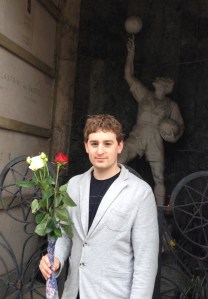
A few days ago I performed with Gandini Juggling in Bergamo, home to some of the best pizza in the world, inventor of Stracciatella ice-cream and the resting place of one of the greatest and most influential jugglers of all time, Enrico Rastelli.

Arron at the grave of Enrico Rastelli

Even though it was only a short trip to Italy we managed to fit in a visit to Rastelli’s grave, a first for me and something I’ve wanted to do for a long time.

As an atheist it felt a little odd to wonder through a grave yard so heavily entrenched in religious symbols. But it was a fitting time and location to reflect on Rastelli’s achievements. While I don’t believe his spirit was looking down on us as we placed the flowers by his feet I’d like to think that if Rastelli were alive then he’d appreciate the gesture.

It was nice to know I was treading in the footsteps of other jugglers who had been to the grave before me. It also reminded me that I really must get round to visiting Cinquevalli‘s grave in South London.

Perhaps as jugglers we care more about pioneers of our art than other circus performers or perhaps we’re just more pompous. I’ve never heard of aerialists or acrobats visiting the grave of someone who pushed their particular discipline, but I could easily be ignorant of the facts. I hope so.

If you’ve ever visited the grave of a famous circus performer or proprietor I’d love to know more, leave a comment below.

Changing Direction

A common question in the contemporary circus world right now seems to be “where are all the circus directors?”

People are researching and writing, looking within and without for an answer. But the answer is actually pretty simple if you think about it. They are all in Russia, telling people what to do.

Valentin Gneushev
Valentin Gneushev, Russian artistic director, choreographer. Photo by Mikhail Evstafiev.

That seems to be the major issue at the heart of the “modern” circus director. If circus now is all about the individual, their personal desires and motivations, then what role is the “director” meant to fulfil? Heaven forbid that the director should tell the artist what they should actually be doing!

I do describe one part of my work as “director”: but it very rarely takes the form of the kind of work that we expect from a film or theatre director. And indeed, strange new job descriptions have emerged as the circus community tries to define the role of circus director. “Outside eye” being one of my personal favourites… Or we try to avoid the issue altogether by bringing in dramaturgists or choreographers rather than directors.

The most successful contemporary circus directors seem to be those who create shows that they claim to be based around honesty and realism and individuality: made with and for the specific artists involved. Yet strangely, most of those shows also seem to carry on working well with replacement casts and new disciplines. Is it possible that these contemporary circus directors are more about spin than content?

Some of the most successful modern circus shows in our brief history have been the product of the French school system. Shows where a theatre director or dance choreographer were brought in to create a show with the students. Here perhaps the director’s role is more real than in many productions, but even here the artists were already “booked”, the skills already fixed. So even in these cases, the director’s role was to mould the material given to him, rather than to start with his own pure artistic desires.

This is not to say that the power of the artists personal values should be entirely discounted. Looking to the East, Moscow’s Valentin Gneushev [1] was incredibly successful in the late-80s to mid-90s with his modern circus act productions. He started with a concept, often inspired by paintings or other artworks, and then sought out the artist that he wanted to make the act with. Having worked in Variety shows with many of “his” acts, I feel strongly that the most convincing of these acts are those where the artistic concept meets the personality of the performer. In other words, those cases where Gneushev found exactly the right artist to personify his concept. Obvious of course, just as a film director also looks for the right leading man for his movie: but in both cases, the original concept comes from the director, NOT from the performer.

So where does that leave us today? We do need circus directors who can listen to the sensibilities of the circus artist: directors who can find the core within the individual and help to bring it out. But at the same time, we need directors who can take responsibility for the content: to make artistic decisions, and to use the artists themselves to communicate the directors intentions.

We need circus directors who, when neccesary, aren’t afraid to tell circus artists what to do.

[1] http://en.wikipedia.org/wiki/Valentin_Gneushev

Practice Systems for Juggling: Completing Halves

Practice System 3: Completing Halves

Explanation

Completing Halves is a system that, like Five Lives, is also set as a game. Similar to Five Lives, it is designed to work on solidifying one pattern. The advantage to this system is that it can last as long as you want it to last. If you only have 5 minutes, it can last five minutes. Likewise, if you want to train your one trick for an hour, then this could also work for you. This system is rough and ready to go: simple and effective.

Example

Below is an example of Completing Halves using 5 ring pancakes:

1. Make and attempt at your longest run with 5 ring pancakes. Let’s say you get 25 catches when you drop.
2. Half the amount to get 12.5, which is rounded up to 13.
3. You know have three attempts to get 13 catches clean.
4. If you achieve this within your three attempts, then return to step 1, constantly trying to beat your personal best. If you do not manage to get your 13 catches clean within three attempts, then half it again to get 6.5, rounded up to 7, and repeat the process again.

This is a very simple system, yet I feel it is very effective. I personally enjoy the fact that it is so simple, and isn’t time dependant.

I hope you enjoy it, and I would very much appreciate any thoughts, feedback and questions that you may have on the subject. Have fun!

Undermän

The full Undermän show (as part of CircusFest) was live streamed on the Guardian website here and you can still watch it!

I personally loved the show, so much so I gave a breif testimonial for the show. Obviously the video isn’t as good as seeing the show live but if you haven’t had a chance to catch the show yet have a gander!