Practice Systems for Juggling: Five Lives

Practice System 2: Five Lives

Explanation

Five Lives is a system that I came up with which is specifically designed for solidifying patterns. Unlike the pyramid system, the amount of throws and catches can change, depending on your skill level that day. An advantage about this system over the pyramid system, is that you cannot fail. Another advantage about this system is that it is quick to complete. I personally find this very useful as I sometimes have to train in limited space facilities. This means that I could just have 20 or 30 minutes spare before I have to move space. This system is perfect for just that situation.

Example

As this is set as a short game, you start with fives lives. Every time a level is not achieved, you go back to the previous level and loos a life. Below is an example of a standard game of Five Lives with 7 balls.

First you set your levels.

7 throws (a flash) = level 1

10 throws = level 2

20 throws = level 3

30 throws = level 4

40 throws = level 5

50 throws = level 6

Etc etc.

Now, you start on level 1. As it is level 1, you have 1 attempt to get your target. If you fail, you loose a life. If you succeed, move onto level 2. Now you are on level 2, you have 2 attempts to achieve your target. If you fail, go back one level to level 1 and loose a life. If you succeed, move onto level 3. This sequence continues until you eventually run out of lives. Take note of your highest level and see if you can beat it next time.

This system can also work hand in hand with the Pyramid System (for explanation of Pyramid System, please see previous article). Once you have died (in the game), remember your highest achievement of that round. Make this the top of your Pyramid System for that day and create your pyramid from the top working down.

Example

My highest achievement in Five Lives today was 30 catches of 7 balls. My pyramid for today could look like this:

30 catches x 1

20 catches x 2

15 catches x 3

10 catches x 4

7 catches x 5

I hope that you have as much fun with this system as I have. If you have any questions or comments then please do leave them below. Thank-you.

Things Jugglers Say

I have always liked kick-up tricks with clubs, and have over the years somewhat specialised in them to a greater or lesser degree, including teaching workshops at juggling conventions specifically about that particular trick, and releasing a couple of videos onto the internets based around some of the variations possible. This has lead to me being perhaps somewhat known in the juggling community for this particular trick.

Yesterday I performed my club juggling act at an event held at a circus institution: a press conference type show with circus students and teachers, and various city officials in attendance.

It wasn’t my best show, but I did my job reasonably well, and was, as far as I could tell, well received by all. After the show, one of the jugglers (who had mentioned already that he had done one of my above mentioned workshops some years ago, and was also very interested in kick-ups himself) complimented me on my act, and then followed that up with: “but you don’t do many kick-ups in your act.”

I agreed with him, and talked a little about how I have been doing less kick-ups in general in recent years, due to the wear that they put on the knees and ankles, and the worsening injuries that that in turn entails.

Whilst this is true, and there are specific kick-up variations that I no longer practice for that reason, I have now thought a little more about his statement, and what it could mean.

For the fact of the matter is, that in the act I performed, which lead directly to the comment of “you don’t do many kick-ups in your act”, I do 5 different kick-up variations, for a total of 43 individual kick-ups in a 6 minute act.

That actually seems like quite a lot of kick-ups!

Is it me? Do I think I’m doing a lot and I’m not really? Perhaps, but no-one has ever said to me before that “it’s not very many kick-ups.” Quite the opposite, in fact: audience members commenting specifically on the kick-ups (rather than the absence thereof) is a rather common occurrence. But to be clear now, I refer now to non-juggler audience members.

I don’t know how possible it ever is for us to put ourselves truly in the position of the audience, to overcome our preconceptions of technique, to enter into the mindset of the outsider. And as I have surely written before, the responsibility to mould that mindset rests strongly with us as performers. But we have to first be clear ourselves as to what we are communicating.

A lot of modern/contemporary/new-school/creative/manipulation-based juggling is based around non-repeating patterns. About short sequences, single throws and rapid changes. And in some ways, I find that to be a shame. Only variation and repetition can lead to images and recognition, and I consider such things to be important aspects of our juggling reality.

Perhaps my 5 kick-up variations are too few? Or the repeating patterns too many? But too few for who, and too many based on what criteria, exactly?

How many variations on a theme are too much? When does repetition cross the line from boring pattern to strong image (and back again)? As a juggler, can I ever truly “see” my juggling from the outside?

And how do I know how many kick-ups is enough?

Practice Systems for Juggling: Pyramid System

In the ever growing world of juggling, people are improving, at different rates, all over the world. As the saying goes, practice makes perfect. The thing that surprises me is that a lot of jugglers are happy to spend hours practicing their hobby, but do not train in a structured and organised manner. I am constantly surprised at people who arrive at the training space, completely unaware of what they intend to practice and how to do it. I am however impressed at the increase of skill made by people with good practice discipline as opposed to those with no or bad practice structure.

As juggling is a huge part of my life, I have spent time trying to find the most efficient way to practice. I understand that not everyone likes to practice in the same way, and that some systems will suit some people more than others, but I have seen some people slog away at a trick for years with no progress, and I am shocked that they haven’t tried to find the reason why. I firmly believe that if you find a practice system that is good for you, then you shouldn’t strictly only stick to that chosen system. I feel it is important to mix things up, try other practice structures and challenge yourself.

I am not the creator of these systems. Some of the systems I have fused with others to develop them in ways that I feel make them stronger. I have also, taken inspiration from some systems, to develop others in ways that are more suitable for me. I’m not claiming that all of these systems are going to work for you.

These methods are starting points for you to test for yourself and see if:

  1. You enjoy them.
  2. See any improvements in your juggling.

I’d be interested to hear about your opinions, experiences and own training methods and how they compare to mine so please leave any comments or feedback below.

Practice system 1: Pyramid system

Explanation
The Pyramid system is a common and efficient juggling system. Though at times it can be tedious to execute, if you are dedicated to it, you WILL get results. This system is suited mostly to patterns as opposed to tricks. The main goal of this system is to solidify patterns to a consistent level.

Example: 5 clubs

  • 5 catches (a flash) x 10
  • 10 catches x 7
  • 15 catches x 5
  • 20 catches x 3
  • 25 catches x 1

Above is a pretty classic example of a Pyramid system. Obviously the Pyramid will be altered depending on one’s level. You must complete the first layer, in this case the flash x 10, before you proceed to the next level, and so on.

Creating your Pyramid
In order to begin this splendid exercise, you first need to create your perfect Pyramid. I am sure there are many ways to do this, but here is the method that I would use if I was creating a Pyramid for 7 balls.

  1. Find the amount of catches that you know you can achieve. For me, I know I have achieved 100 catches a few times. So this is going to be the top of my pyramid, because if I get this, I will be very happy.
  2. Next, I would work my way down to the second layer, to just over half way. For me I will have 30 catches. This I will have to achieve three times. I go just over half way because I feel that if I waste my energy doing 35 catches, then 40, then 45, that I do not have enough energy to concentrate on the full 100 catches. But that’s just me.
  3. Next I will go down to the third layer which is 20 catches. I will have to achieve this 5 times.
  4. The second to last layer I use is 10 catches this I want to get 7 times. This is the amount I would ideally like to perform.
  5. Finally I get to just a flash. This I try to make as perfect as possible and do this 10 times. As one should always start from the bottom of the Pyramid, the first exercise should be easy, and should act as a warm up for what is to come.

Now that that is my Pyramid designed, I would now have to execute it. Starting at the bottom and working my way up to the top. In doing this I would take regular short breaks (maximum 1 minute) every 5 minutes. If I do not achieve my Pyramid that day, then that is ok. It’s either too hard for me, or I’m just having a bad day. Give yourself a time limit. If your Pyramid isn’t complete in say 30 minutes, then admit defeat and try again tomorrow.

I hope that this practice method helps in someway. If there are any questions then please email me at jon.udry@gmail.com

Have fun!

Fully Committed – A brief rant about Online Diaries.

The online diary should be a very handy thing. I fill in my available dates on an agency’s website and the agency knows when I’m available for work. The idea is that they can save time by telling a potential client which acts are free on a particular day without having to phone around. This apparently simple bit of streamlining has many problems when put into practice and is in fact a complete waste of time and effort.

So many diaries – So little time.

I’m on the books of many different agencies (possibly as many as 50). If they all start insisting that I keep their diary up to date then my entire professional life will be spent updating diaries. Of course, the only thing I will ever fill in is “busy filling in diaries” over and over again. This is assuming I can remember 50 different user names and passwords that are often allocated by the agency system and can’t be changed to “username” and “password” like I did with my bank account. Keeping your own diary up to date can be a struggle at times. Adding even a couple more does nobody any favours.

What, where, when???

The whole point of an online diary is so that an agency knows whether or not I’m available. In reality, this depends on what I’m being asked to do and where & when I’m being asked to do it. Most of the website diary systems I’ve seen are fairly black and white. On any given day you are either “Booked” or “Available”. Some let you distinguish between AM and PM but even when you can include this level of detail, problems can easily arise. If my diary says that I’m booked on March 19th, PM, then I might miss out on another booking in that time slot. That should be fine but the new booking may be just down the road or begin 4 hours later in plenty of time to travel from one to the other. ‘PM’ is 12 hours long after all.

I am not the sort of act that drops out of a gig as soon as a better one comes along. Despite my belief in the first come first served ethic, I was once offered a job that paid (without exaggeration) twenty times more than the one I had in the diary. It was over several days and the pre-existing gig was just one afternoon. As it turned out, I managed to pass the one-day gig on to another performer with no harm to agent, client or myself. I took the new gig but had I been using the new agency’s diary system I wonder if I would have been offered it at all.

You can always leave a date un-booked if you think there is a chance of working elsewhere in the same timeslot or if it’s a gig you can easily pass on, but this can make you look like you’re not working at all or not updating the diary properly. Either of these can make you look bad to the agency (as does writing nasty articles about their diary systems – sorry).

Last Minute Larry

Diaries change very fast. Even with the best of intentions, they go out of date very suddenly. You might hear of a gig cancellation and be ruled out of a possible replacement gig five minutes later as you simply haven’t had a chance to update all of your diaries.

I’ve presented arguments like these to various agents and they usually say the same thing, “Don’t worry Sam, we’ll always call you if we get a potential booking”. If this is the case, then what is the point of the diary? If the agent still has to make the call, no time or money has been saved. Sometimes I’ve been told, “We just want a general idea of when you’re around.” This seems pointless too but is probably the best argument in favour of online diaries. If you are working on a cruise ship for several months then perhaps you can save everyone some time by mentioning the fact but it gets a lot more fiddly with one-day bookings. It could also help when you are away on holiday but there are even gigs worth cancelling a holiday for.

I have a theory that agencies only insist on diaries because they’ve forked out a lot of money for the software that manages them. Software that sends out 20 identical text messages from your PC is probably cheaper and certainly more effective. In the age of the smart phone, people are not difficult to get hold of.

Happily, most of the agencies that trial a diary system seem to abandon it after a few months leading me to believe that I’m not the only one who feels this way.

There are some companies though, that seem to persist with their diaries and I’d very much like to discuss it with them.

If only there was some way of knowing when they’d be around?

Sam Veale – March 2012

Synthetic Video

Jugglers prepare for depression/inspiration (depending on your philosophical out look on life), Wes Peden has released his most recent pay for view video digital download, entitled ‘Synthetic’. And it’s epic.

I should probably write a little more on the contents but I’m not going to bother, you all know the deal. If Wes puts 18 months into a project you know it’s going be worth €15!

Buy ‘Synthetic’ here!

I guess if you really need to know more then have a read of this blurb by Wes…

Synthetic is a film displaying the new work of Wes Peden. The material was inspired, in a concrete way, by the strength of each prop and how to best take advantage of these qualities. The general aesthetic of the juggling was particularly influences by asymmetry, clarity, and trick shape.

The video is 45 minutes long and comes with an additional 25 minutes of bonus tricks and remixes. inside you will find 3 club slapping sequences, the coolest 5 ball pirouette Wes has ever done, 25 new ring patterns, a German 6 ball piece, 3 balls and a sweater, THE THROWING AWAY SECTION, the holy club/cuphead/ball part, site specific head rolls, flipping forehead balances, the 2012 five club routine, and so very much many more!

Circus and Celebrity

After reading ‘Who Was Philip Asteley?‘ by Nell Stroud (co-founder of Giffords Circus) I got thinking about the lack of modern day circus celebrities.

Why are there no circus celebrities?

I think it’s important to define what I mean by ‘circus celebrity’. I mean an individual widely known throughout society who becomes and stays famous because of their circus work.

Astley's Amphitheatre in London circa 1808.
Astley's Amphitheatre in London. Image via Wikipedia

In the past when circus was one of, if not the primary form of entertainment there were many minor circus celebrities and a few superstars such as Philip Astley and Jules Léotard.

Older members of the public might know the name of some past famous clowns but it’s unlikely they will know the names of any trapeze artists or acrobats. But artists from other circus disciplines have made it to the top of the bill and become household names in the past. It may surprise some of you to know that there have been few juggling celebrities equivalent to the David Beckhams of the world today. Both Enrico Rastelli and Paul Cinquevalli enjoyed fame and fortune, with sell out shows and even product endorsements.

As circus lost it’s status as the number one entertainment destination house hold circus names went in decline. Cinema and then TV created starts of their own that were better suited to their medium. The best way to become famous in the past was to appear on TV or in a film, if the guys in charge wen’t interested in you then your were out of luck.

But now we have the internet.

We all have access to our own publishing company and film studio. Society is diversifying. Individuals are forming their own tribes of like-minded people, no longer held back by geographic constraints.  Within these communities artists and experts appear and become ‘micro-celebrities’. These tribes are linked by individuals who belong to more than one tribe and share an aspect of one tribe to another. Often these connecting individuals will share their favorite artist or expert, turning a micro-celebrity into a ‘hyperlink star’.

I think it’s a matter of time till a circus performer/entrepreneur becomes famous, someone will be at the right place, at the right time, have the right attitude, image and work. And it could be good for all of us. Someone able to interest society at large in circus would mean more ticket sales and more competition, resulting in a better standard of work.

It’s what Philip Astley, P.T. Barnum and Guy Laliberté did. Only when they did it they could rely on interruption marketing. Shouting on a street corner and hoping people would stop. But now everyone is shouting. So you have to create your own tribe and rely on connectors sharing  your art on Facebook, Twitter and the rest. Build your fan base and let your fans build you. But people will only share your work if it is remarkable.

So make remarkable work that others can share, become famous and then share your success. Simple.

(Sorry if you were looking for an article about celebrity circus, fortunately you’ve missed reading about that for at least another click!)

Russian Roulette

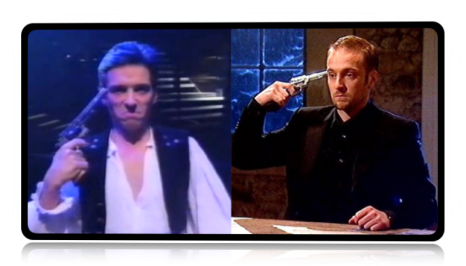
Russian Roulette: Simon Drake vs. Derren Brown.Russian Roulette

Both of the above performers produced versions of the Russian Roulette game/trick for British television. Drake’s was a 70 second routine for a closing act of an episode during the second series of The Secret Cabaret in 1992. Brown’s was built up with the actual stunt performed live as the closing 10 minute segment of an hour long special.

I find both of these performances to be masterly and beautiful pieces of theatre. These are magic acts made specifically for TV, and choreographed and directed perfectly for that medium. And I find that the massively differing decisions taken in each case in terms of that staging allow a (possibly) useful study. Well, they might. Let’s find out!

Simon Drake – The Secret Cabaret (1992)

Derren Brown – Plays Russian Roulette Live (2003)
(15 minute edit, with the complete live segment)

Despite the long length of Brown’s final presentation, both versions are staged in a minimal manner: so what differences come over when we compare the minute long piece to the hour long presentation?

Let’s start with “believability”. Which of the pieces is more real? Drake’s is certainly more of a “theatre” piece, allowing us the distance to simply watch and draw our own conclusions. Do we really believe he is in any real danger? Perhaps not, but I don’t find that this diminishes from the effect in any way (the same way as I know that Juliet doesn’t really die, yet I can still feel the emotional content of the play as if she did). Brown’s version on the other hand is set up to make it more “real”. He goes out of his way to convince us of how real it is. To convince us at every opportunity of the tricks fairness and danger.

It is far easier to dismiss Drake’s as “just a trick”, but is that an issue? Can we enjoy it more because we are given less information? Does Brown’s insistence on the fairness and truth of the situation actually give us more inclination to search for a method?

Both the performers act (and react) as if it were a genuine stunt, with a genuine risk of death (check their pre- and post-gunshot reactions!). But we accept the danger in Drake’s staging without having to have it explained to us. The music, sound effects, imagery etc communicate the danger. Brown tells us (literally) exactly what the dangers and risks are.

Brown’s presentation also led to a gentle backlash when it became clear that all wasn’t exactly as it seemed. A police statement claimed that despite the script, “there was no live ammunition involved and at no time was anyone at risk.” Was Brown’s insistence on “fairness” and “real danger” too much?

How much information do we need to give the viewer? And perhaps more to the point in terms of circus, how much of that information is already there? There in the technique, or in the cultural history, or in the audience’s own experiences?

When the “story” of the act is as clear as in Russian Roulette, how much extra information do we need to put on to make the act even stronger? I can imagine that Brown’s version lives on stronger in the collective cultural memory: but this is also related to general popularity and famousness, of course. Is it stronger as a piece of theatre than Drake’s 70 second telling?

I find both these pieces to be incredibly strong works of art – and the massive divide between them in terms of running time simply shows the two extremes of staging. The actual trick, the act of Russian Roulette, loading a single bullet into a revolver chamber and guessing (with death being the result of failure) where the bullet lies, is a stark and reduced piece of magic. Simon Drake chose to highlight the feat by cutting it to the bare minimum, whilst Derren Brown took the opposite route – making each step as open and clear as possible.

When the effect (the trick, the act) is clear and strong, then the staging needs to be at least as lucid and direct. How we create that clarity is down to our own artistic needs and choices. And in these two extreme examples we see that staggeringly different presentations can create a similar emotional impact. What they share is clarity, directness, and simplicity in their final execution.

Story telling

Occasionally I hear circus artists/directors/random people who feel their opinion is important talk about ‘how to make circus more than just an act’, about how we can use circus to ‘tell stories’. As Mr. Wilson has so eliquentley commented on this before I’m inclined not to comment as I would be just wasting keystrokes.

However if you must layer on a storyline do it well. This video could help you do that:

Circus Posters

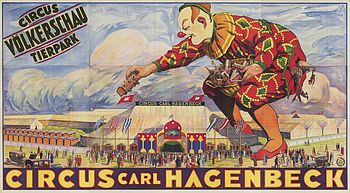
I love old circus posters.

I love the colours, fonts and (obviously) the circus that go towards the make up of a great poster. I love the thickness, size and feel of them. I love the stories from old circus families of poster wars, where completing circuses would tear down or worse, cover the competitions posters with their own. I hope that in an age of Facebook adds and pay per click that the humble circus poster still has it’s place in the marketing budget.

I recently came across CircusMuseum.nl which has some great images and really easy to search database. Here are a couple of my favourites…

Make sure to have a read of the Taschen circus book, full of great circus posters.

If you have a favourite poster please share the image link below.

Teachers Week

Right now I am sitting in the backseat of a small van / large car: sandwiched comfortably between a yoga teacher and an aerialist. In the front seats are a burlesque performer and, driving, one of our two producers. We are en route to our second venue as part of the Cwtch Cabaret tour in Wales.
www.cwtchcabaret.co.uk

But I want to write now not about touring in the UK (which is a great and wonderful novelty for me!), but about a project which shows once more that jugglers are the geekiest of the circus community.

Earlier this month I was in Berlin for a week, participating in the first Juggling Teachers Meeting, held at the Berlin Juggling Center. Arranged by the centres owner, Alan Blim (the original founder of Berlin’s Juggling Katakomben), this five day workshop was supported by a European initiative for teaching, and had participants from Hungary, the Czech Republic, the UK, Italy, Spain, and of course Germany.
Berlin Juggling Center

So in all we had around a dozen students, and four teachers completed the group: myself, Alan Blim, Marco Paoletti, and Tim Roberts (long-time juggling teacher at the Chalôns school, now head of Higher Education at the Circus Space in London, and president of FEDEC).

Each of us was to teach a day (and to participate as students in the other days), and a target of the week was not only to teach our usual workshops or themes, but also to go deeper into the actual teaching theory behind our work. Each teacher had their own style and manner of course, which also meant that different teachers went at different levels, and in differing depths, into the theoretical aspects behind their teaching.

It became clear by the third day that teaching juggling in general can be divided into two large and different themes: long-term teaching (such as at a professional circus school, with the same students over a period of years), and short-term (like an hour workshop at a juggling convention). Knowing the context that the teaching is happening in informs the content and the detail of the work that is appropriate. Long-term teaching allows more personal research, and the teacher-student relationship can be more equal, with the teacher taking on something of a professor or mentor-like role. In short-term teaching, quicker results are usually desired by the students, and it can be more important to place focus on quick results – cool tricks or simple sequences.

Each of the four teachers material and teaching styles were very different from each other, but common themes showed themselves each days: suggesting that there is some common or shared vocabulary amongst us all. Building a strong foundation of technique and content, creating neutral space for new creation, exploring existing elements as deeply as possible, and noticing (and then breaking) habits we have formed.

Another major topic of discussion was a theme which I have talked about in previous blogs here: the reasons for, and the consequences of, the lack of permanent juggling teachers in comparison to those of other disciplines. As I have also postulated, I believe this is part of the reason for jugglers, historically speaking, pushing further creatively than other artists. But that has always seemed to be an accident of the situation (caused by students having a multitude of visiting, performing teachers), rather than the schools explicitly choosing to provide teaching in that manner.

The desire was always to create something more tangible from the weeks research, and through Tim’s involvement came the decision to write a juggling teachers manual for FEDEC. FEDEC has an ongoing project to create training manuals (free to download from the FEDEC website) for the circus disciplines, to promote exchange between the schools and a good level of teaching across all subjects. There are ten “chapters” so far, and two further (single wheel and straps) already in production. They start with the most basic of technique and preparatory work, before moving onto more advanced material. It became clear that the juggling manual doesn’t need low-level teaching material (the juggling students at the professional circus schools already enter with a high technique level), and so the focus shall be more directly centred on the artistic and theoretical aspects of the work.
www.fedec.eu

Perhaps that approach can then feed back into the other disciplines, just as we jugglers can learn from them. It is also hoped that the work that was begun over the week can be continued and added to: to arrange another meeting, perhaps in London, with a greater mix of teachers with a greater range of experience and styles. Although the week was inspiring and felt very important, it also felt very much like a first step – a step towards a bigger and clearer project.

What Sideshow Is Not . . .

sideshow

Sideshow is not:

1. “Jackass” in any way shape or form.  Just because you are a fan of the show or the movies does not make you an expert in the centuries old arts of Circus Sideshow, the Bally Stage, the Old Ten in One, or simply stapling your ball sack to the side of your leg (reference on the last one, see: “Jackass”)

2. Magic.  Magic is trickery, sleight of hand or “gaffing”.  Sideshow is real, real nails, real glass, real fire, real danger.  In the words of a great Sideshow artist, George the Giant, “Magic tries to make you believe that it’s real; Sideshow makes you wish to hell that it wasn’t.”

3. A Party Trick.  It is a “Stunt;” because of the fact that Sideshow is real it takes a lot of training and discipline combined with proper technique and skill level to not get hurt.  Half of what we do during any given performance can quite possibly kill us several different ways if we do not perform the stunt properly.

4. For Children.  Due to the fact that Circus Sideshow is real, dangerous and life-threatening, it may not be the kind of entertainment you would want to bring your child to.  Though that being said we have performed to the delight and extreme delicious horror for older children in the past.  Some kids are just built for it I guess and we will probably be seeing them on stage in the future – who knows?

5. For Women.  Women are far to delicate for this sort of thing and really we don’t want to mar their pretty faces.  I’m sure they would jus faint and pass out at just the idea of the stunts let alone performing them, and . . . and . . .  ——- I’m sorry I just can’t say this with a straight face and without laughing.  Who are we kidding?  I work with the most rockin’ group of Ladies that do things that make the burliest me squeele.  Lol! (www.sideshowsirens.com)

Patfield on beauty

Juggler, rope walker and friend of mine Chris Patfield recently wrote this article for the Guardian:

http://www.guardian.co.uk/commentisfree/2012/feb/19/beauty-of-highwire-walking

This bit reminded me of an older post I shared here

 It saddens me to see that this great discipline is increasingly rare in contemporary circus, which no longer invests as much in high-risk performances such as the highwire or trapeze.

Shifting Goals

Warning: This post is a bit of an ego boost, sorry! 

I don’t think I’ve ever subscribed to the “I’ve just flashed X number of objects” of approach to juggling. I’ve never set up a camera and spent 35mins trying one trick that’s probably too hard for me, I did today…

When I started juggling (10 or so years ago) juggling 7 clubs was a big deal. Very few could even blag it and even fewer performed it consistently on stage (this hasn’t changed yet). A well known juggling book* has this to say about The Seven Club Cascade, “…it is highly unlikely the more than one or two readers will ever have the actual experience of driving this pattern”. Funny how such statements date so quickly.

The love it or hate it the WJF should be partly credited to the rise of more 7 club jugglers.

And this makes you wonder what’s possible….

*Guess the juggling book